
Sighisoara: The Clock Tower & Citadel Museums
Inside the Sighisoara Clock Tower: the history museum floor by floor, the clock figures, the torture room, the weapons collection, tickets and hours.
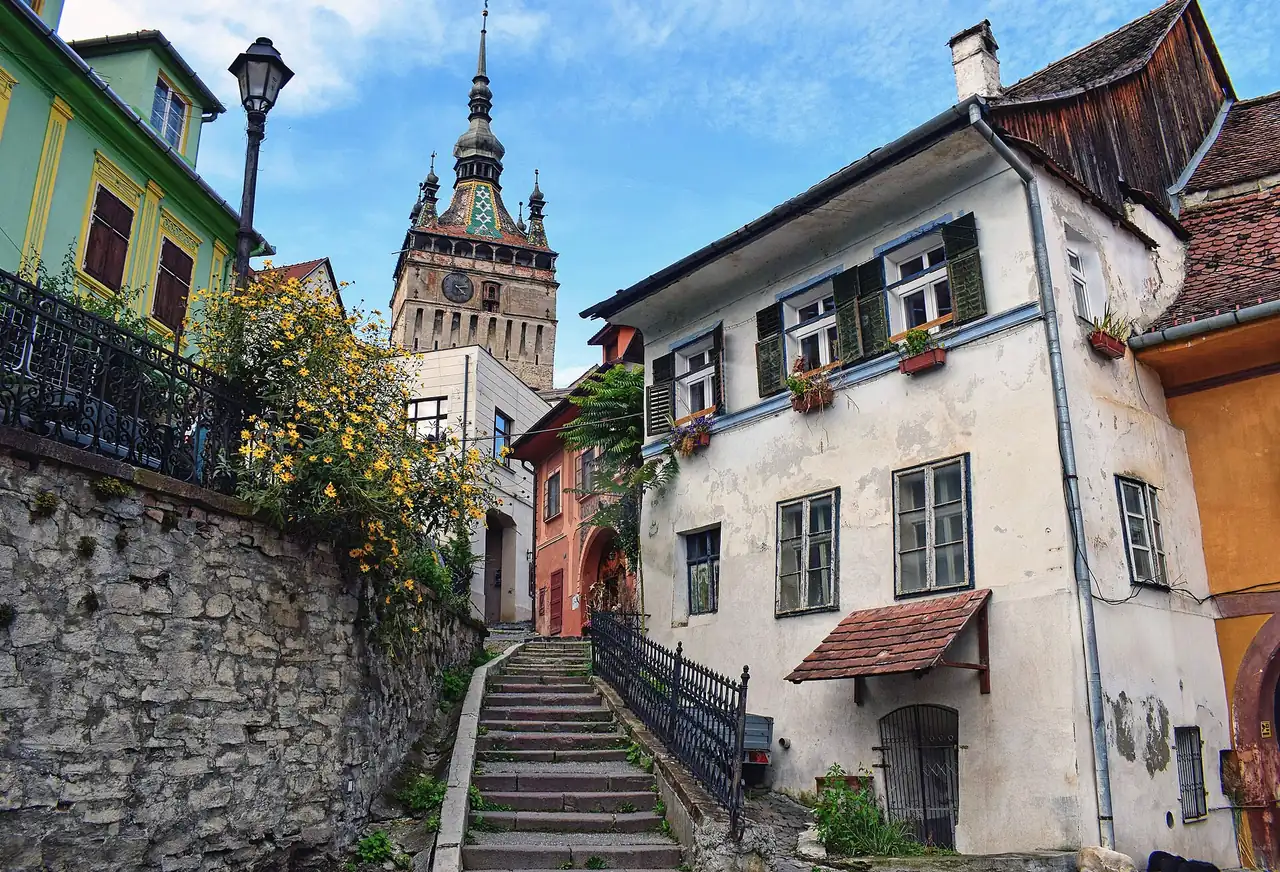
The Clock Tower is the gate into the Sighisoara citadel and the town museum in one building, and the ticket buys you six floors of exhibits plus the view over every red roof in the old town. The same museum service runs two smaller spaces: the torture room in the passage under the tower and the medieval weapons collection, which sits on the floor above the restaurant in Casa Vlad Dracul, a minute’s walk away. Adult entry to the tower is 50 lei, the combined ticket for all three is 70 lei, and everything closes on Mondays.
Get the money question straight first, because this is where old advice bites. Plenty of blogs and listings still quote 12 to 20 lei for the tower and six lei for the torture room; the tariff published by the town hall’s museum service for 2026 is 50 lei for the tower, 20 for the weapons collection and 15 for the torture room, with the 70-lei combined ticket saving you 15. Bring cash in lei and treat the desk as the final word, not a printout from two years ago.
What is actually inside the tower?
The museum moved in here in 1899: the local physician Josef Bacon founded it and it opened on 24 June that year. The collection is arranged vertically over six levels connected by 110 steps, so you climb through it rather than walk around it, and each landing is a different subject.
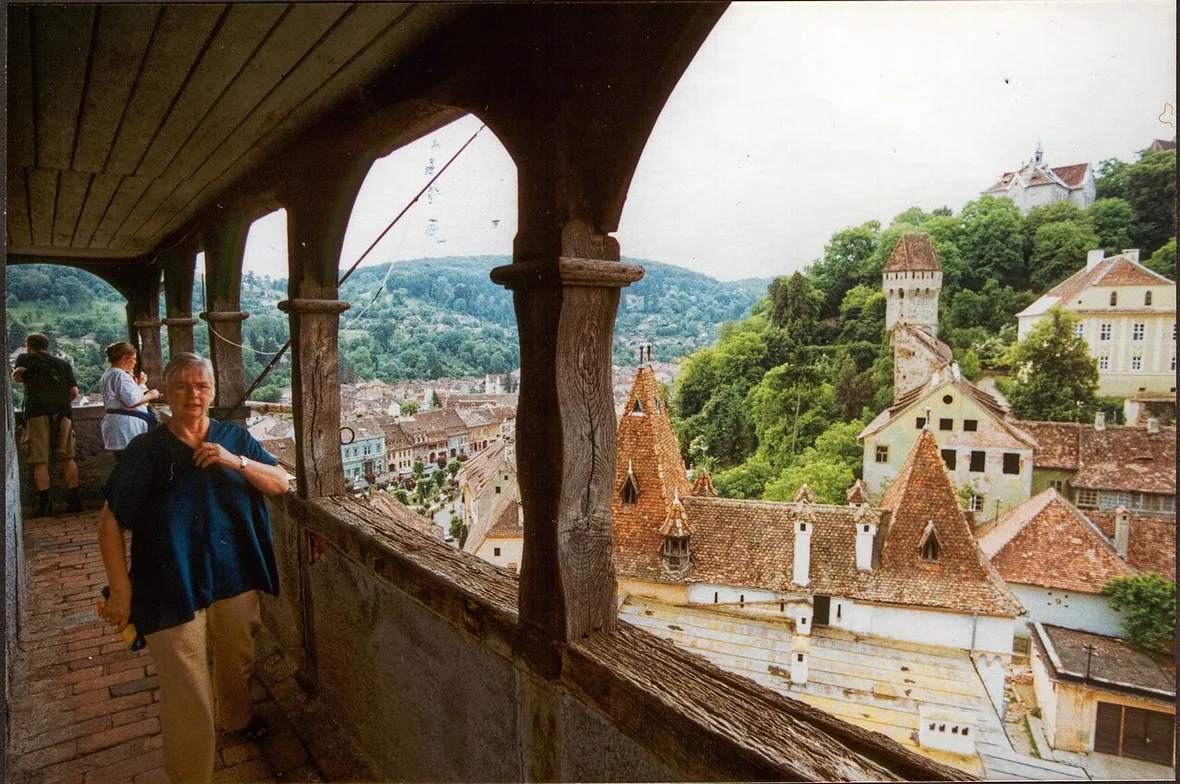
The lower floors carry the town’s own story, including a scale model of the fortress that’s worth a proper look, because it shows you the shape of the walls and towers you’re about to walk through. Above that comes the old pharmacy, laid out with period instruments and labelled bottles, then the guild rooms with the tools and finished work of the crafts that built and defended the place, followed by ceramics, furniture and a collection of antique clocks. The top level opens onto the wooden viewing gallery that wraps the tower, and that’s where most people spend half their visit.
The clock, the seven gods and the four turrets
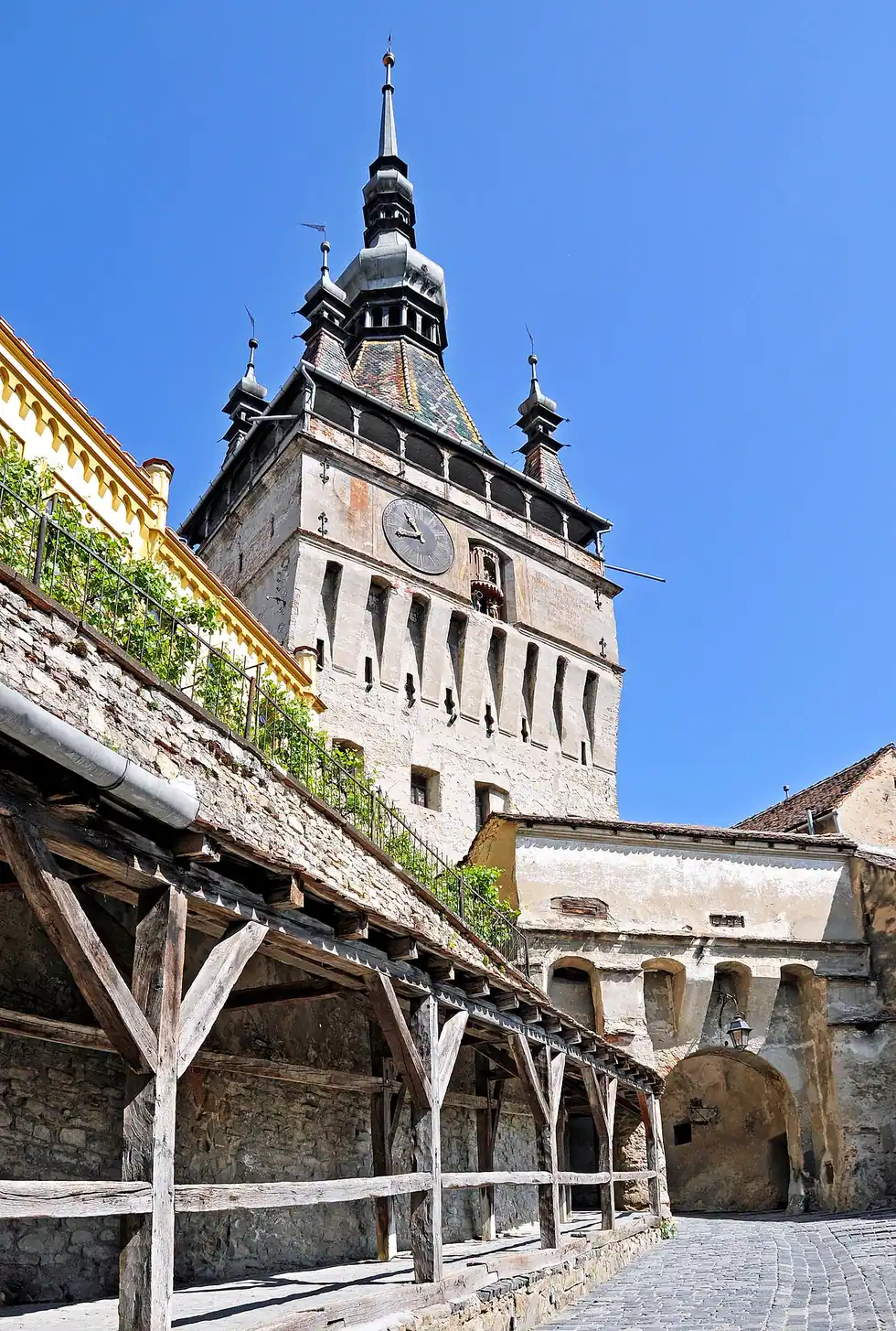
The clock is the reason to look up. Two dials, each 2.3 metres across, carry hand-painted black and gold numerals, and behind them sit two mechanisms, an older wooden one and a newer metal one; an electric motor was added in 1964 without changing anything you can see. Beside the dial is the theatre. Seven figures carved in linden wood stand on a rotating platform, one for each day of the week, and only one is visible at a time through the ornamented opening.
Each figure is a Roman god with its planet and its metal, which gives you something to do while you wait for a gap in the crowd. Diana, the moon and silver hold Monday; Mars and iron have Tuesday; Mercury and quicksilver Wednesday; Jupiter and tin Thursday; Venus and copper Friday; Saturn and lead Saturday; and the crowned sun with gold takes Sunday. Work out the day, then check the niche to see whether the right god is on duty. The platform turns once every 24 hours, at midnight, so nobody standing in the square at noon is going to watch them change.
The rest of the carved cast is Justice and Righteousness, two drummers, Pax the goddess of peace, and the angels of Day and Night, with an executioner on the face that looks down at the lower town. The four small turrets on the corners of the roof aren’t decoration either: they were a legal sign, the mark of a town with judicial autonomy that could pass a death sentence and carry it out. That’s the thread running through this building, and it leads directly to the room under your feet. The roof itself is younger than the tower, which is 64 metres tall and served as the town hall until 1656: fire gutted the building in 1676, and three craftsmen, Veit Gruber from Tyrol, Philip Bong from Salzburg and a carpenter named Valentinus, rebuilt it between March and September 1677 for 650 florins. The coloured tiles arrived in 1894.
The torture room under the tower
This is the part most day-trippers walk past, and it’s the most interesting fifteen minutes in the citadel. The room sits in the wall of the passage beneath the tower. It was sealed up after the great fire of 30 April 1676, then reopened as a military prison, and through the 18th century it served as the town’s torture chamber. The communist authorities closed it, and it came back as a museum space in 1998.
The star exhibit isn’t a rack or a set of thumbscrews but a stone. It weighs six kilograms and was hung round the neck of anyone sentenced to stand at the pillar of infamy in the citadel square, and it carries a German inscription that the museum’s director, Nicolae Tescula, translates roughly as “live in a Christian way, avoid evil, and the stone will no longer hang from your neck”. Public shame as a sentence, with the weight to match. Around it are shackles, a wooden yoke used to move condemned prisoners, and replicas of the Constitutio Criminalis Thereziana of 1768-1769, the last criminal code in this region that still allowed torture during questioning. On the window beams you can pick out the scratched inscriptions of the people who were held here.
The weapons collection above the Dracula restaurant
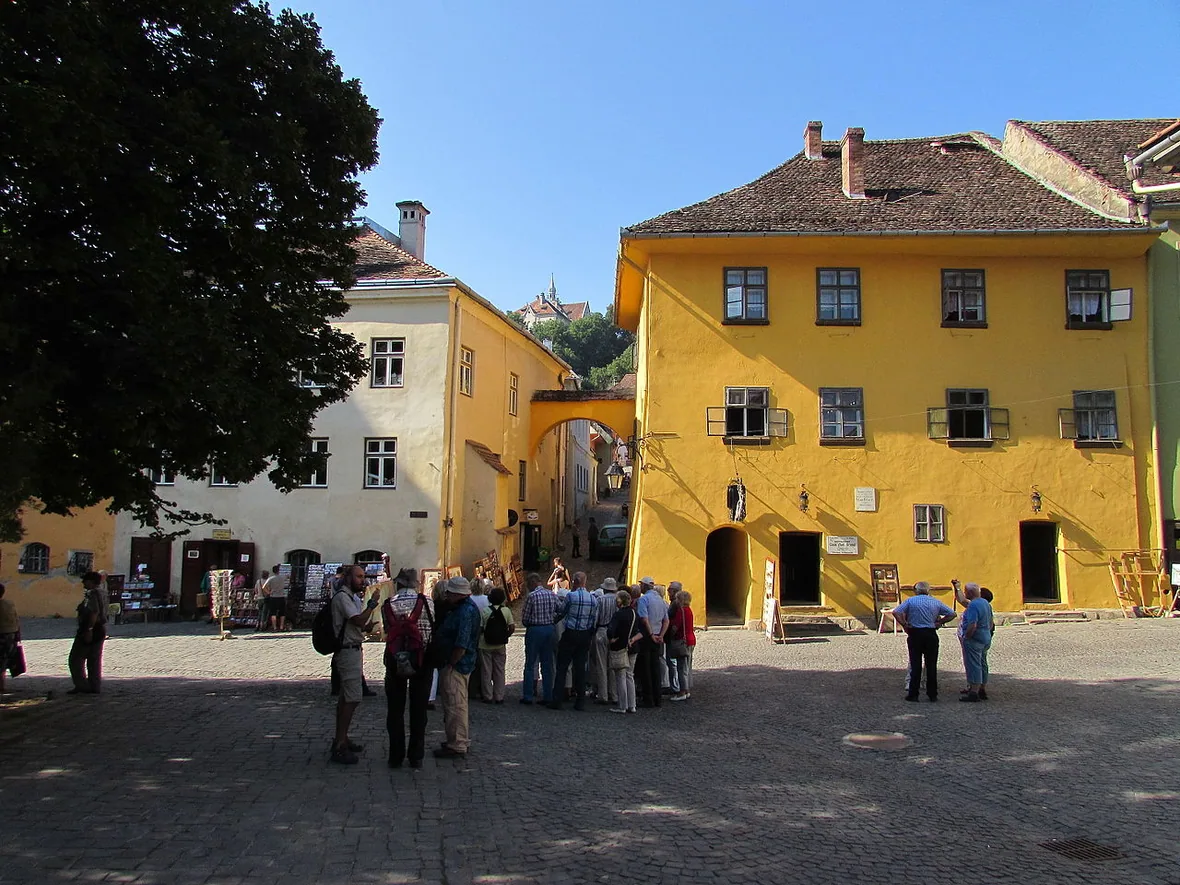
The museum’s third section is the one people miss, because of where it sits: the medieval weapons collection is on the floor above the restaurant in Casa Vlad Dracul, on Strada Cositorarilor between the citadel square and the tower. Most visitors read the restaurant sign, decide the building is a tourist trap and walk on. It’s four rooms, and the range is wider than the citadel’s own fighting history: 13th-century blades sit alongside weapons brought back from the Ottoman lands and from Africa, and the piece the museum is proudest of is a double-barrelled arquebus nicknamed the organ of death, remembered less for what it hit than for the noise it made.
Do the arithmetic at the window. The tower alone is 50 lei and the combined ticket is 70, so the two small rooms together cost 20 lei; the torture room earns that on its own, and the weapons collection is the bonus rather than the reason. One caution: it’s the smallest and quietest of the three, and some recent write-ups describe Casa Vlad Dracul as a restaurant and nothing else, so ask at the tower desk whether the section is open that day, then decide on the combined ticket.
What about the Dracula birthplace itself?
The confusion is worth untangling, because the same building carries two very different things. The restaurant on the ground floor is a private business; the floor above it’s the museum. If you’ve read older accounts of paying a few lei “to see the room upstairs where Vlad was born”, that upstairs is the weapons collection, and its price has moved with the rest of the tariff. As for the claim on the wall, go in for the fun of it rather than the history: the documents only confirm that a mint worked in the building in the 1430s, and the plaque naming it Vlad’s birthplace went up in 1976. Our Sighisoara citadel guide takes that story apart properly, and the wider legend is unpicked in Dracula in Romania.
Hours, timing and how long you need
The museum runs on two seasons, and the summer closing time is genuinely unclear. From 15 May to 15 September it opens Tuesday to Friday at 09:00 and at weekends 10:00 to 17:30, but the weekday close is quoted as 18:30 by the county tourism board and 17:30 by several Romanian listings, while the town hall page that carries the tariff publishes no hours at all and the museum’s own website is dead. Plan on 17:30 and don’t count on anything later as a bonus. From 16 September to 14 May everything closes much earlier, at 15:30. Monday is the weekly closing day for all three sections, which is the single most common way to waste a morning here.
Budget about an hour for the tower if you read the labels, fifteen minutes each for the torture room and the weapons collection, so roughly ninety minutes for the whole combined ticket. The stairs are steep, wooden and narrow in places, with no lift, and the viewing gallery is a tight loop that gets congested when a tour group arrives; go first thing or in the last hour if you can - you’ll beat the tour groups. Late afternoon light is kinder for photographing the roofs from the top, but the winter timetable takes that option away for half the year.
One practical note about money: card acceptance at small municipal museums in Romania is patchy, so bring notes rather than counting on a terminal at the desk.
Where it fits in a day in Sighisoara
Start with the tower and the rest of the day arranges itself: the model of the fortress on the lower landing and the view from the gallery hand you the map of everything else. From the gate it’s a five-minute walk to the covered stairway and the Gothic church at the top of the hill, and the whole upper town is small enough to finish on foot in an afternoon. The full walking plan, the history of the citadel and the where-to-eat detail sit in our Sighisoara guide.
If you’re moving on the same day, the town is on the main railway between Brasov and Cluj, and our Sighisoara to Sibiu guide covers the leg south, with the fortified churches you can fold in on the way. For a full day in the Saxon countryside instead, Biertan is about an hour away and the wider network is mapped in our Saxon villages guide.
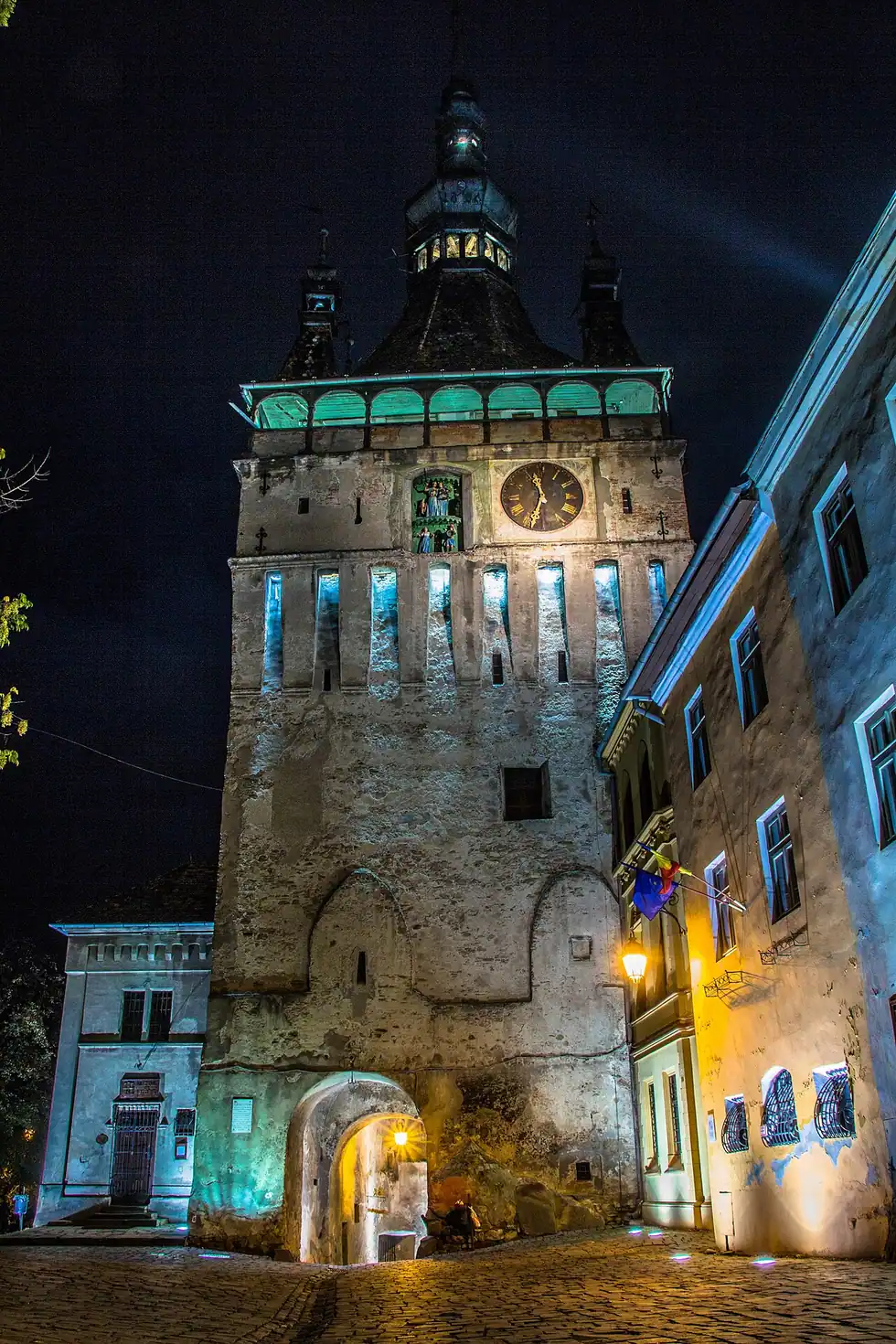
Our where to stay in Sighisoara guide compares the citadel and the Lower Town with real price bands in lei, and the short version is to sleep inside the walls if you can. Coach groups own the citadel from late morning to late afternoon, and the tower square is a different place at seven in the morning or after dark, when the lanterns come on and the tower is floodlit above an empty square. Compare rooms inside the citadel rather than in the lower town, and you get that version of Sighisoara twice, once before the crowd and once after it.
Photos
On the map
The map loads on click - to keep the page lightweight.
The map didn’t load. Check your connection and refresh the page.
Admission and opening hours
- Admission price
- Clock Tower 50 lei adult / 15 lei pupil and student; Medieval Weapons Collection 20 / 5 lei; Torture Room 15 / 4 lei; combined ticket for all three 70 lei (town hall museum page, checked July 2026).
- Opening hours
- Summer (15 May - 15 Sep): Tue-Fri from 09:00, closing between 17:30 and 18:30 depending on which listing you read; Sat-Sun 10:00-17:30. Winter (16 Sep - 14 May): Tue-Fri 09:00-15:30, Sat-Sun 10:00-15:30. Closed Mondays.
Older listings still quote 12-20 lei for the tower, so treat the ticket desk as final. The museum has no working website of its own, the stairs are steep and there is no lift.
Details checked: July 24, 2026
Read also

What to see · 11 min read
Marginimea Sibiului: Shepherd Villages Near Sibiu
Verified · September 5, 202618 shepherd villages west of Sibiu: Rasinari, Sibiel glass icons, Saliste, Paltinis bus fares, and how a day out of town works.

What to see · 9 min read
Prejmer Fortified Church: UNESCO Near Brasov
Verified · September 3, 2026Prejmer fortified church 15 km from Brasov: Greek-cross plan, 275 wall rooms, UNESCO hours for 2026 and how a visit actually works.

What to see · 11 min read
ASTRA Museum Sibiu: Romania's Great Open-Air Village
Verified · August 29, 2026ASTRA Museum near Sibiu: 50-lei tickets, hours by season, how to get there, and which of the 400+ buildings across 96 hectares to see first.

What to see · 10 min read
Bucegi Sphinx & Babele: Cable Car from Busteni
Updated · August 26, 2026Ride the Busteni cable car to the Sphinx and Babele: 2026 return fare 199 lei, hours from 08:30, and how to pair it with Peles or Cantacuzino.