
Biertan Fortified Church: A UNESCO Saxon Stronghold
Biertan fortified church: three rings of wall, the 19-bolt sacristy door, the marital prison, opening hours and tickets, and how to get there.
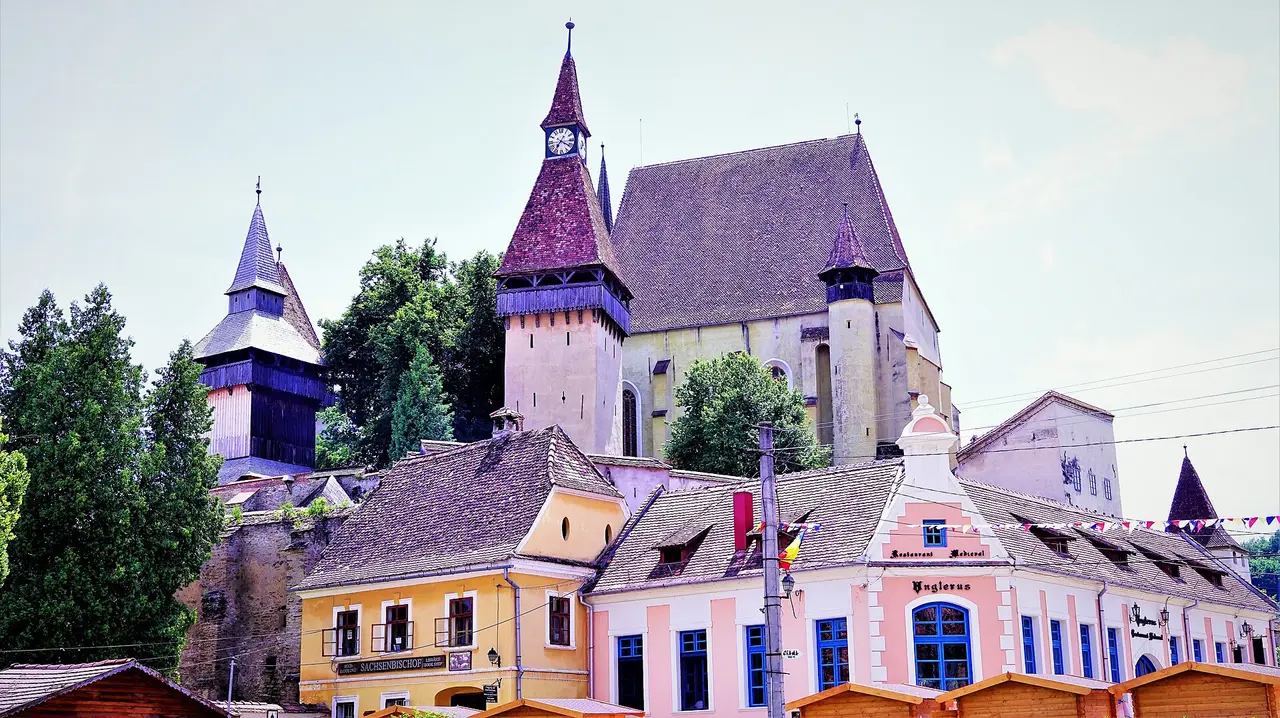
Biertan is the grandest of Transylvania’s fortified Saxon churches and the easiest to reach of the UNESCO seven: a late Gothic hall church on a hillock in the middle of the village, wrapped in three rings of defensive wall linked by towers and covered stairways. It went up between 1486 and 1524, served as the seat of the Saxon Lutheran bishops from 1572 to 1867, and holds the largest multi-panelled altarpiece in Transylvania along with a sacristy door whose single key shoots nineteen bolts. Entry is around 10 lei, it opens Tuesday to Sunday with a lunch break, and you need a car to get there.
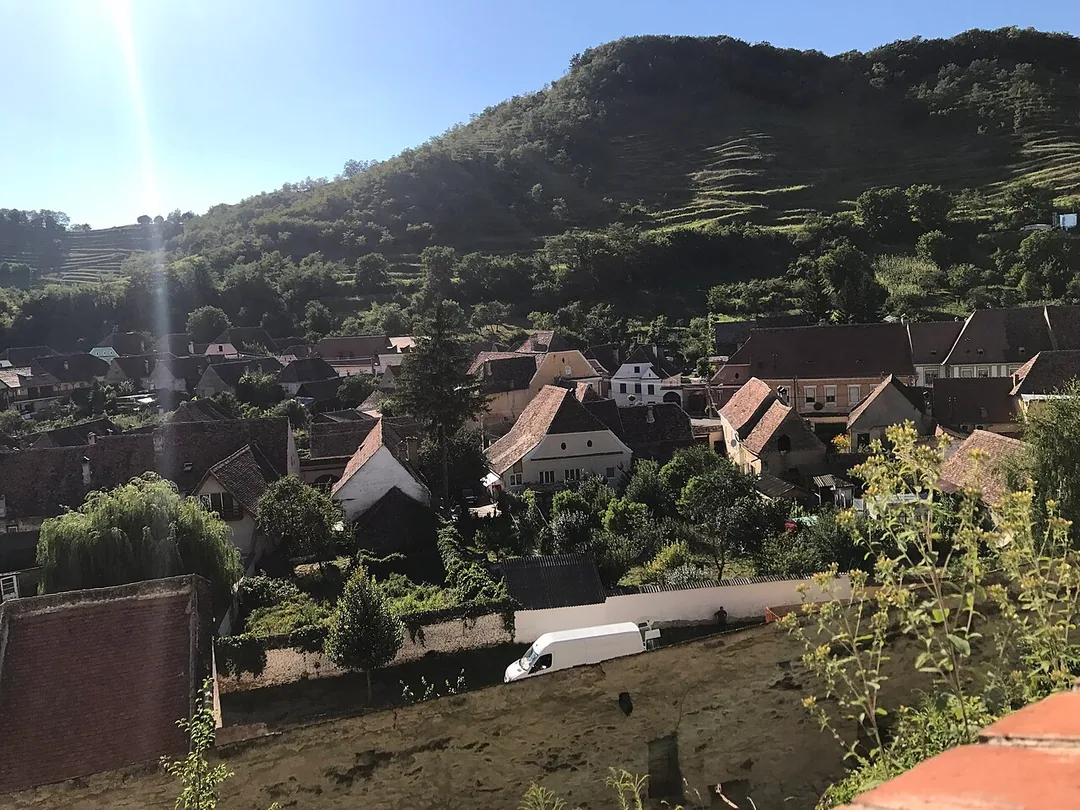
The village sits 21 km east of Medias and about 29 km west of Sighisoara, in the folded hill country between the Tarnava valleys, and the approach is half the pleasure: vineyard terraces, a straggle of Saxon houses, then the whole fortress rising over the roofs. Don’t give it the twenty minutes a tour coach allows - give it a full hour, because the details here, the lock, the bishops’ tombstones, the prison for unhappy couples, are what separate Biertan from a pretty church you photograph from the road.
Why a village church looks like a fortress
The Transylvanian Saxons were German colonists invited east from the twelfth century to farm and defend the frontier of the Hungarian kingdom. They were free peasants and townsmen, not nobles, so when Ottoman and Tatar raids swept through there was no lord’s castle to shelter in. They fortified the one large stone building each village owned, and the result is a building type that you’ll barely find elsewhere: a Gothic nave inside a ring fortress, with store rooms and bacon lofts built into the ramparts so a village could hold out for weeks.
Biertan is the ambitious version of that idea. It has three tiers of wall, standing around eleven metres high in places, connected by towers and gates, with the earliest ring going back to the fourteenth century and the outer works finished in the sixteenth and seventeenth. Nine towers survive, along with a clock tower and a bell tower, and covered wooden stairways climb between the levels so defenders could move under cover. Our Saxon villages guide sets out how the other six compare; this is the one where the fortifications are still legible at a glance.
The church: a hall church built for a bishopric
Construction ran from 1486 to 1524 on the footprint of an earlier Romanesque church, and the result is late Gothic with Renaissance touches: a hall church with three naves of the same height, rib vaults overhead, dedicated to the Virgin Mary. Those equal-height naves are the giveaway of a wealthy parish, because a hall church needs more stone and more skill than the usual basilica plan, and Biertan grew rich on wine and trade.
Its status jumped in 1572, when it became the see of the Lutheran bishops of the Transylvanian Saxons, and it held that role until 1867. That’s nearly three centuries as the spiritual capital of an entire community, which explains the scale of a church in a village of a couple of thousand people. The bishops’ carved tombstones are gathered in one of the towers, a small, quiet gallery of Latin inscriptions that most visitors walk straight past.
What to look for inside
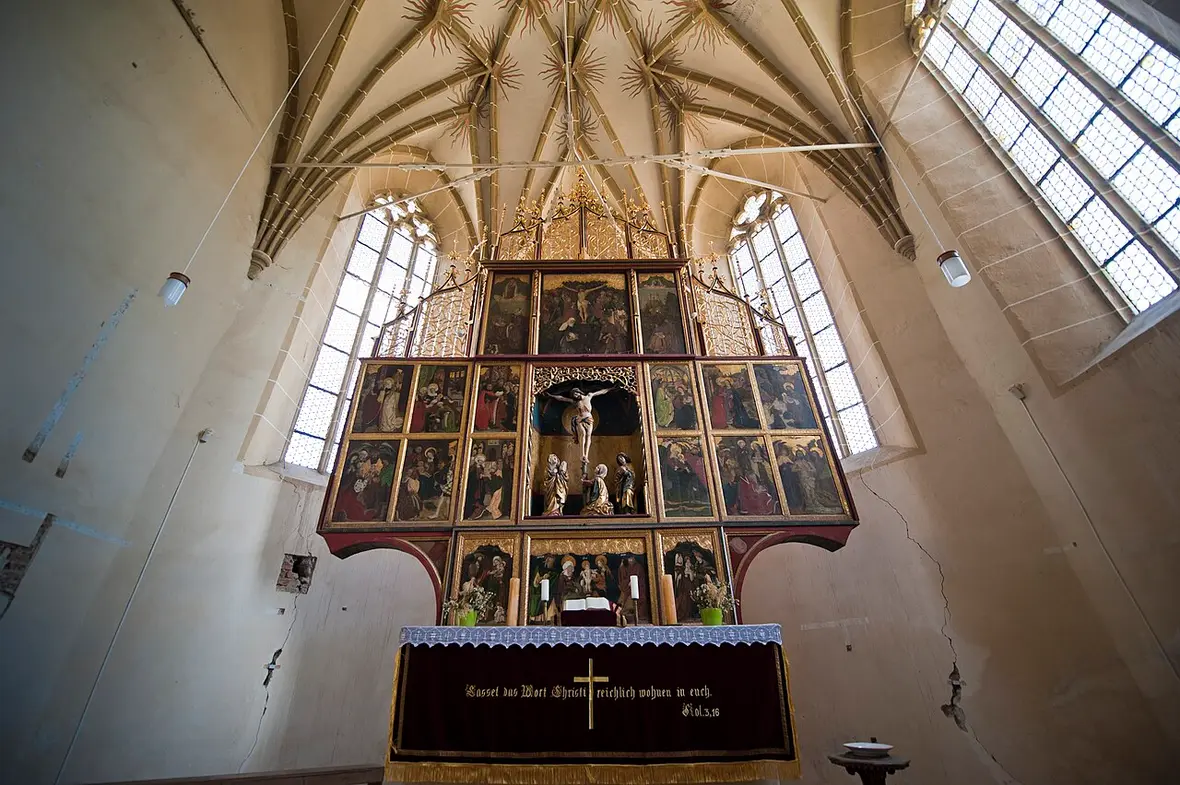
The altarpiece is the headline. Made between the 1480s and 1513 by craftsmen from Vienna and Nuremberg, this polyptych carries 28 painted panels and is the largest multi-panelled wooden altar in Transylvania, tall enough to fill the chancel from floor to vault. Take the time to read it rather than photograph it: the panels run a sequence of scenes that a mostly illiterate congregation was meant to follow like a picture book.
Beside it, the stone pulpit carved in 1523 deserves a minute of your attention, and behind the chancel sits the object everyone remembers.
The door with nineteen bolts
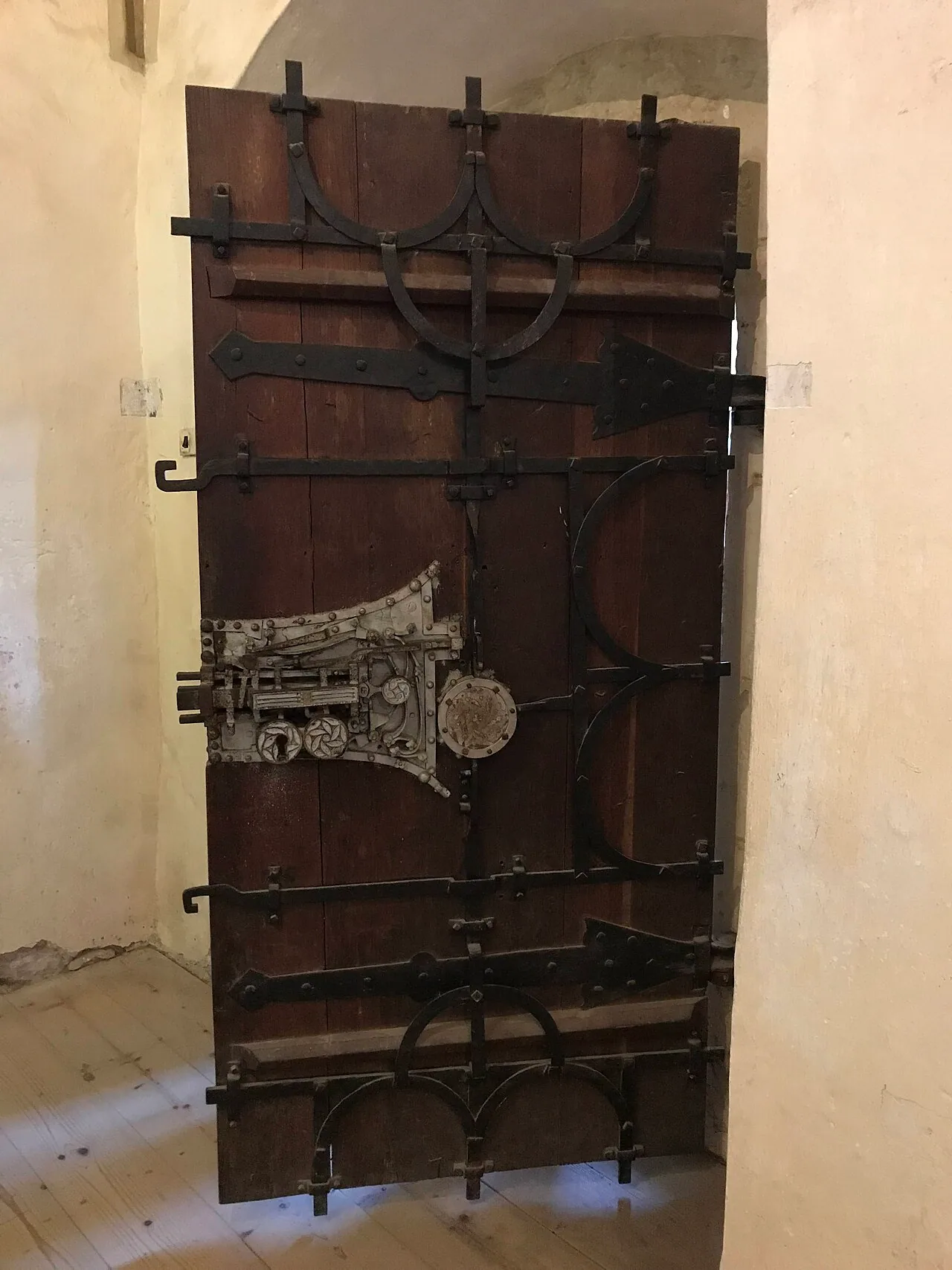
The sacristy door was made in 1515, and its lock throws nineteen separate bolts from one turn of the key, driven by a mechanism of rods and gears mounted openly on the face of the door so you can watch it work. It was built to protect what the village stored behind it: church treasure, documents, and the valuables families carried inside the walls when raiders came. The mechanism was admired enough to be shown at a Paris world exhibition at the end of the nineteenth century, where it won a prize.
What makes it worth standing in front of is that it isn’t a museum reconstruction. This is the original door, five centuries old, and the lock still functions. In a country full of restored castles with invented armouries, that authenticity is rare, and it’s the single strongest argument for driving out here.
The marital prison
Tucked against the walls is a small room with a story that has travelled further than the church itself. When a Saxon couple in Biertan wanted a divorce, the bishop sent them here first: one room, one bed, one table, one chair, one plate, one set of cutlery, and the door locked behind them. Accounts differ on the length of the sentence, from a fortnight to as long as six weeks, and church records claim that in more than three centuries of use only one couple came out still wanting to separate.
Treat the story with the affection it deserves rather than as hard sociology; the surviving records are thin and generations of guides have polished the tale. But the room exists, the single-plate logic is real, and it says something true about how tightly these communities were governed by their church. It also lands better in person than in print, standing in a cell the size of a garden shed.
Getting there, hours and tickets
You need a car, or a taxi and patience. Biertan sits off the main roads; the nearest railway station is Dumbraveni, roughly 13 km north, and there’s no useful scheduled bus from either Sighisoara or Sibiu. The drive from Sighisoara takes about forty minutes, from Medias twenty-five, and from Sibiu an hour and a quarter, all of it on decent surfaced roads with a short village lane at the end. Our car rental in Romania guide covers what to expect on deposits and the road vignette.
The church opens Tuesday to Sunday, 10:00 to 13:00 and 14:00 to 19:00, and the national tourism board lists admission at 10 lei, while some 2026 listings quote 15 to 20; carry small notes in lei either way. The lunch break is genuinely observed, which catches out people who arrive at 13:15 having driven an hour, so aim for mid-morning or mid-afternoon. Out of season the gates are sometimes locked and the keyholder is nearby: the standard advice is to ask at the Unglerus complex beside the church rather than to give up and drive away.
When to turn up
Early is better. The coaches that do the Sighisoara to Sibiu run tend to arrive late morning, so the courtyard is at its quietest right after opening, and the low light on the walls is better then too. Late afternoon works as a second-best window, once the day trips have moved on and before the seven o’clock close.
Season matters more here than at a castle with a ticket office and a rota of guides. Summer is straightforward, spring and early autumn are the prettiest, with the vineyard terraces turning over the village, and winter is the gamble: shorter light, occasional locked gates, and the keyholder to hunt down. Biertan is also the gathering place for the Transylvanian Saxon diaspora, who return to the village each year for a reunion, so it’s worth a quick look for events if a quiet visit is the point.
Two more churches in the same commune
Here’s the part almost nobody uses. The commune of Biertan takes in two more villages, Richis and Copsa Mare, and each has its own fortified church. They’re a few kilometres away on quiet lanes, they see a fraction of the visitors, and at Richis you may well have the place to yourself while a coach party fills the courtyard at Biertan. If Biertan leaves you wanting more and you’ve got an hour spare, this is the best possible use of it.
The same caveat applies to opening hours in the smaller villages: there may be no fixed schedule at all, and access often means finding whoever holds the key, usually signposted or known to any neighbour. It’s a slightly awkward, entirely rewarding way to see the region, and it’s close to how the fortified churches were experienced before anyone thought to put them on a heritage list.
Fitting Biertan into a trip
Biertan works best as a stop rather than a destination. It sits almost exactly between Sighisoara and Sibiu, so the natural move is to build it into that transfer and see it on the way rather than driving out and back. Coming from Sighisoara, our Sighisoara guide covers the citadel to do first thing in the morning; arriving in Sibiu afterwards, the Sibiu travel guide picks up the evening.
If you have to choose a base, Sighisoara is closer and more atmospheric, Sibiu is bigger and has the airport and the restaurants. Either puts Biertan within a comfortable half day, and both are better places to sleep than the village itself, which has guesthouses but very little else once the church closes at seven.
If Biertan is one stop among several rather than a single detour, our Saxon villages route strings it together with Viscri, Rupea and the little-visited village of Malancrav into a full two-day drive between Sighisoara and Sibiu. From the Brasov side the matching church page is Prejmer fortified church.
Photos
Admission and opening hours
- Admission price
- Admission listed at 10 lei by the national tourism board; some 2026 listings quote 15-20 lei. Bring cash in lei.
- Opening hours
- Tuesday to Sunday 10:00-13:00 and 14:00-19:00. In winter the gates may be locked; ask at the Unglerus complex next door.
Hours and the ticket price change with the season and the keyholder, and the lunch break is real. Confirm locally before making a long detour. Checked July 2026.
Details checked: July 23, 2026
Read also

What to see · 11 min read
Marginimea Sibiului: Shepherd Villages Near Sibiu
Verified · September 5, 202618 shepherd villages west of Sibiu: Rasinari, Sibiel glass icons, Saliste, Paltinis bus fares, and how a day out of town works.

What to see · 9 min read
Prejmer Fortified Church: UNESCO Near Brasov
Verified · September 3, 2026Prejmer fortified church 15 km from Brasov: Greek-cross plan, 275 wall rooms, UNESCO hours for 2026 and how a visit actually works.

What to see · 11 min read
ASTRA Museum Sibiu: Romania's Great Open-Air Village
Verified · August 29, 2026ASTRA Museum near Sibiu: 50-lei tickets, hours by season, how to get there, and which of the 400+ buildings across 96 hectares to see first.

What to see · 10 min read
Bucegi Sphinx & Babele: Cable Car from Busteni
Updated · August 26, 2026Ride the Busteni cable car to the Sphinx and Babele: 2026 return fare 199 lei, hours from 08:30, and how to pair it with Peles or Cantacuzino.