
Corvin Castle (Hunedoara): Visiting Guide
Corvin Castle, the largest Gothic castle in Transylvania: real ticket prices in lei, opening hours, how to get there from Deva, and the honest Vlad story.
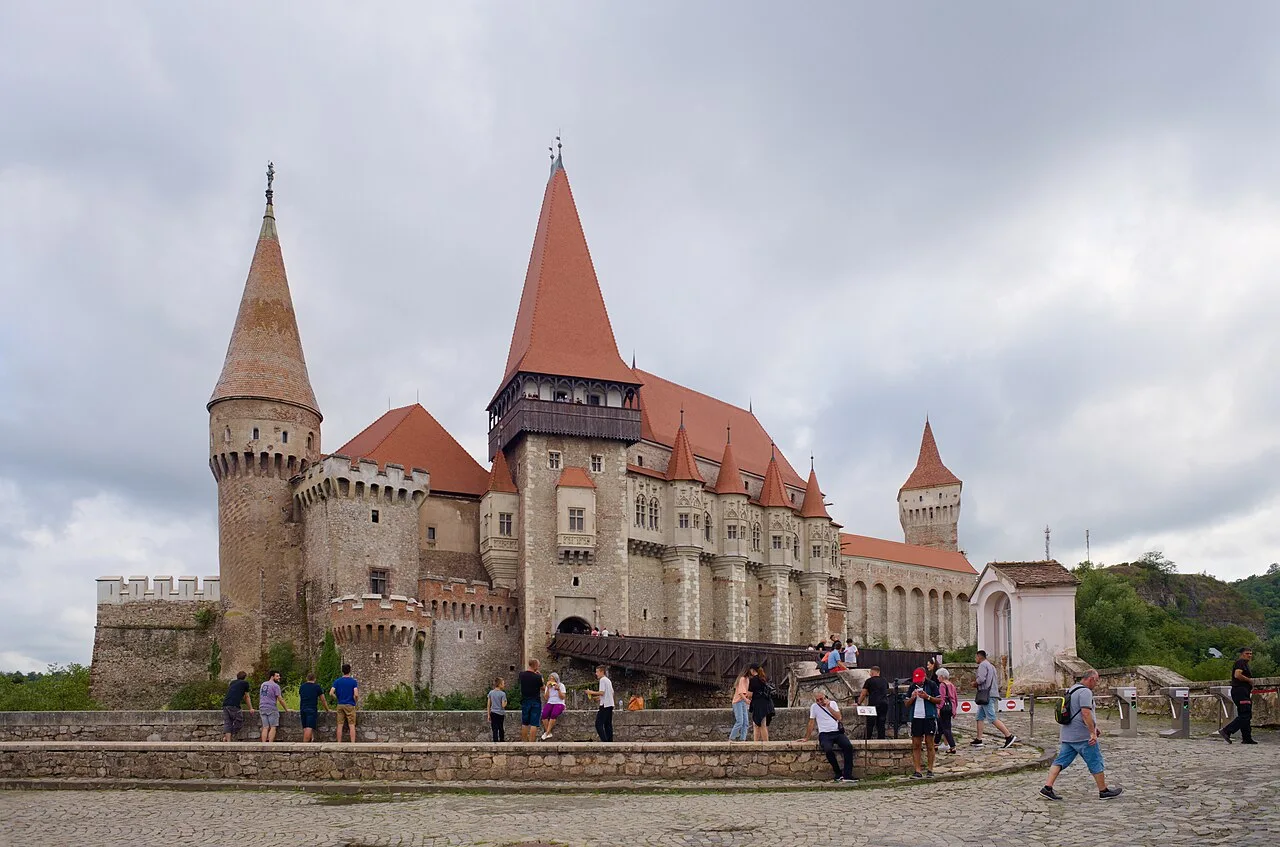
Corvin Castle in Hunedoara is the castle Bran only pretends to be: a huge, genuinely medieval Gothic fortress with a covered wooden bridge, a forest of red-roofed towers and a story that runs back to the 1440s. It’s the largest Gothic castle in Transylvania and one of the biggest in Europe, and unlike the polished Dracula circus down at Bran, it still feels like a real, slightly grim stronghold. The catch is location: it sits in the industrial west of the country, so you have to want to go.
A standard adult ticket is 55 lei, it opens daily (from noon on Mondays), and the easiest way in is a train to Deva and a quick minibus hop to Hunedoara. Budget two to three hours inside. If you’re already chasing the Dracula legend, this is the castle where the story actually has some teeth, because Vlad the Impaler is said to have been imprisoned here, though as usual the truth is messier than the tour guides let on.
Why visit Corvin Castle instead of Bran?
Because it looks and feels far more like the castle in your imagination. Where Bran Castle is a compact, prettified castle-museum full of Queen Marie’s furniture, Corvin is a sprawling war-machine of a place: a rock-top fortress ringed by a river, bristling with round bastions and square towers, reached across a long wooden bridge on stone piers. It photographs like a film set, and gets hired as one often enough to prove the point.
That is the trade-off between the two. Bran wins on convenience and polish, and it’s an easy day trip from Brasov. Corvin wins on scale and atmosphere, but it’s a long way from the tourist trail and the interiors are more bare stone than stately home. If you only see one Transylvanian castle and you’re basing yourself near Brasov, Bran and Peles in Sinaia are the practical pick. If you’re doing a proper loop of the region and you care about the real Middle Ages more than gift shops, Corvin is the more rewarding building by a distance. If it comes down to this fortress against the royal palace, our Peles vs Corvin comparison puts the two head to head on tickets, interiors and how far apart they sit.
What is the history of Corvin Castle?
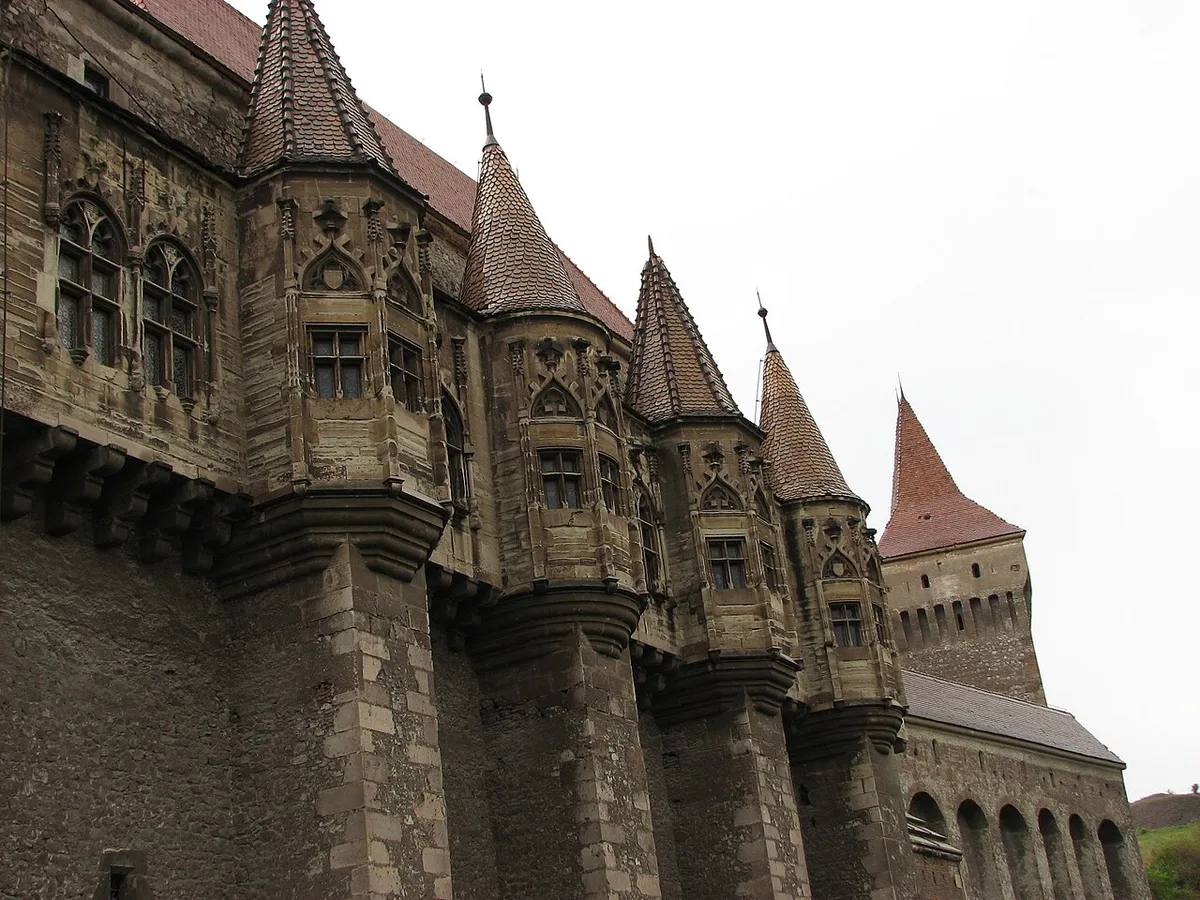
It began as a serious piece of military real estate. From 1446, John Hunyadi (in Romanian, Iancu de Hunedoara), the powerful Voivode of Transylvania and a scourge of the Ottomans, rebuilt an older royal keep here into one of the great fortified residences of central Europe. He set it on a rock above the Zlasti River, so the water and the terrain did half the defending, and his son Matthias Corvinus, later King of Hungary, added to it. The family name, Corvin, comes from the raven (corvus) that appears on their coat of arms, and you’ll see the bird motif around the castle.
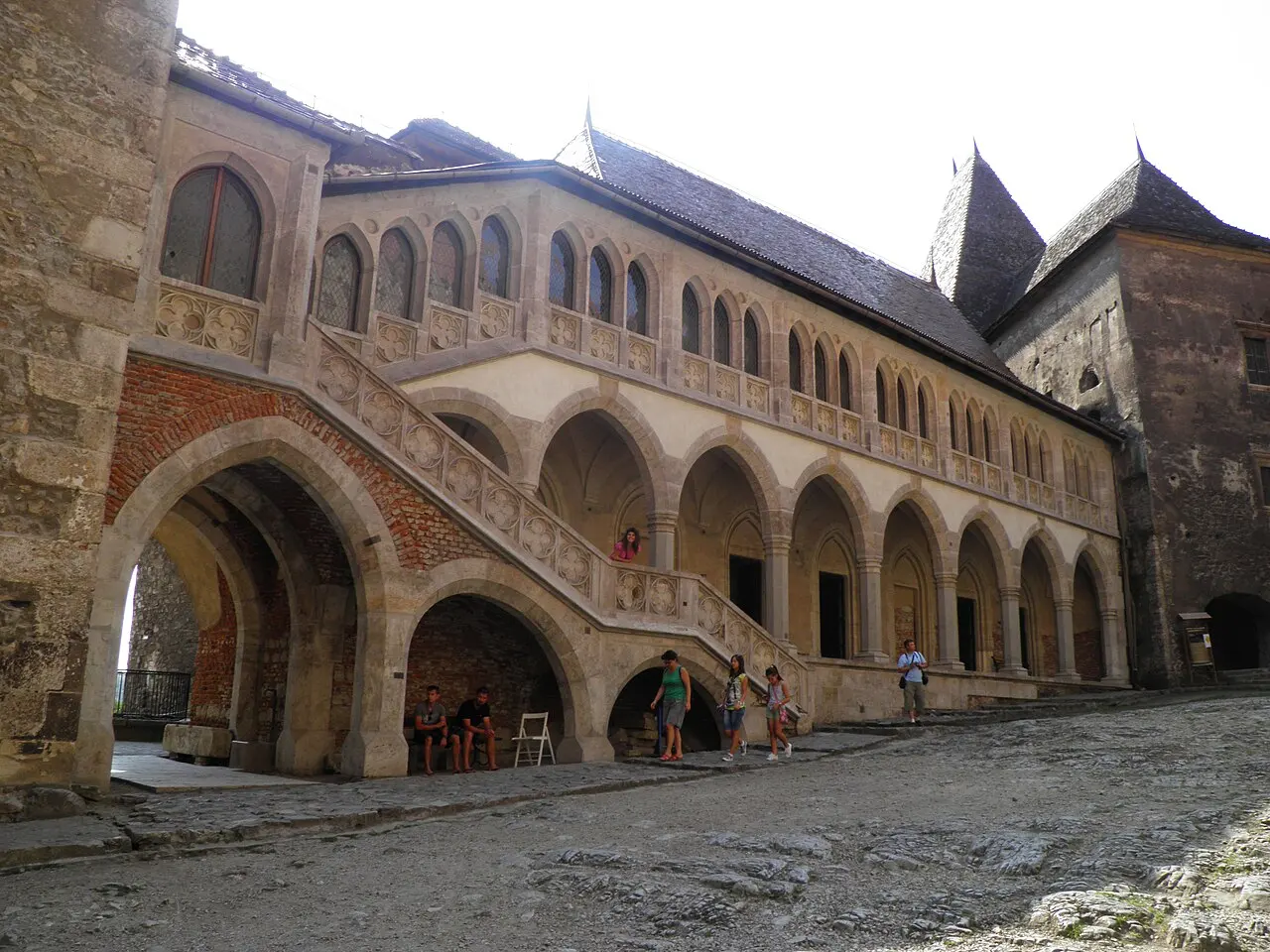
The result is a hybrid you can read in the stonework: heavy Gothic bones with lighter Renaissance touches added later, tall towers and thick curtain walls alongside carved windows, loggias and painted rooms. Two spaces are the showpieces. The Knights’ Hall was the great space for feasts and receptions, and the Diet Hall (the council room) was where business and ceremony happened, decorated with painted medallions. It’s grand enough that Romania counts Corvin among its Seven Wonders, and it pulled in around 276,000 visitors in a single recent year, so you’re not exactly discovering it.
Then came fire. In 1854 a lightning strike gutted the wooden parts, roofs, floors and beams, and the castle was left to rot for a decade before a long, on-and-off restoration began that has run, in various forms, ever since. What that means for you as a visitor is that a lot of what you see is reconstructed rather than original, and the restoration has drawn its share of criticism over the years. It’s still a magnificent shell, but don’t expect every timber to be five hundred years old.
Was Vlad the Impaler really imprisoned here?
This is the question that brings a lot of people, so it is worth being straight about it. The story you’ll hear on site, and in most blogs, is that Vlad III, the Wallachian prince known as Vlad the Impaler and the historical hook behind Bram Stoker’s Dracula, was held prisoner at Corvin by John Hunyadi, sometimes for as long as seven years. It’s a good tale, and it gives the castle a genuine Dracula credential that Bran, honestly, does not have.
The problem is the evidence. There’s no solid historical documentation placing Vlad’s captivity here. Historians generally locate his years as a Hungarian prisoner after 1462 in and around Buda and Visegrad, well to the north, not in Hunedoara. And Stoker, who never came to Romania, had no idea this castle existed when he wrote his novel. So treat the imprisonment as a strong local legend rather than a fact: enjoy the shiver it adds, but don’t repeat it as gospel. The more reliable Dracula link is indirect but real, that Corvin belonged to the Hunyadi family, the great rival-allies of Vlad’s own turbulent dynasty, in exactly his era.
Corvin does have one modern claim to fame that’s completely true, though: it’s a magnet for filmmakers. Its brooding stone has stood in for horror settings in recent films including The Nun and the 2024 Nosferatu remake, which is why it looks so eerily familiar the first time you cross the bridge.
How much are tickets and when is it open?
A standard adult ticket is 55 lei, with pensioners at 30 lei and pupils and students at 15 lei on presentation of ID; preschool children and visitors with disabilities (plus a companion) go free (checked July 2026 on the official site). Worth knowing at the ticket desk: taking photos inside carries a separate 15-lei permit, and if you want a guided tour in English it’s 100 lei on top, versus 60 lei in Romanian. Booking online isn’t really necessary here the way it’s at Bran, but do watch out for third-party resellers advertising “skip the line” tickets at a markup, since the queue is rarely bad enough to justify it.
In the main season, from 1 April to 30 September, the castle runs Tuesday to Sunday 09:00 to 20:00, with a later noon start on Mondays. That is a genuinely long day, so there’s no need to rush. The catch is winter: the off-season hours are shorter and, frustratingly, the official site does not publish them clearly, so if you’re visiting between October and March, phone or email ahead (the number is on castelulcorvinilor.ro) rather than trusting a random figure online. Give yourself two to three hours inside to do the halls, the towers, the bridge and the courtyard justice.
How do you get to Corvin Castle?
The castle is in Hunedoara, in the west of Transylvania, and the key to reaching it’s the nearby city of Deva, about 16 to 18 km north. Deva sits on Romania’s main east-west railway, with direct trains from Bucharest, Cluj-Napoca, Timisoara, Arad and beyond, so almost everyone arrives via Deva rather than trying to reach Hunedoara’s own quiet station directly.
From Deva, the last leg is easy and cheap: frequent minibuses (microbuze) run to Hunedoara throughout the day, roughly every 15 to 20 minutes, take about half an hour, and cost only around 13 lei each way, picking up near the Deva train station. Once you’re in Hunedoara the castle is about 1.5 km from the centre, an easy 20-minute walk that is signposted, or a short local bus or a cheap taxi if you would rather not. Fares and timetables shift, so check the current departures on autogari.ro; the last minibus back to Deva isn’t a given.
Driving is the other strong option, and it changes the trip completely. Hunedoara sits just off the A1 motorway corridor near Deva and Simeria, so with your own car Corvin becomes a straightforward stop rather than a mission, and there’s parking near the castle. A hire car also lets you fold it into a bigger western loop with Alba Iulia’s citadel or the road up into the Retezat mountains. One warning: this isn’t a realistic day trip from Bucharest, which is the far side of the country, several hours away by road or rail. Corvin makes sense either as a slow-travel stop on a cross-country route or from a base in Sibiu, Timisoara or Cluj.
Where does Corvin fit in a Transylvania trip?
Think of Corvin as the western anchor of the region, not a Brasov side-trip. It pairs naturally with a west-to-east (or east-to-west) drive across Transylvania rather than with the castle cluster around the Carpathian passes. If you are planning that kind of loop, our Transylvania road trip lays out how the medieval towns and fortresses connect, and Corvin slots in neatly on the Deva side. For a completely different, far older layer of the same county’s past, the Dacian capital of Sarmizegetusa Regia sits high in the Orastie Mountains about an hour’s drive away, an easy pairing for a history-heavy day.
A good rhythm is to combine it with the Saxon south. From Hunedoara it’s a manageable drive east to Sibiu and then on to the fortified churches and the hilltop lanes of Sighisoara, Vlad the Impaler’s actual birthplace, which ties the Dracula thread together far more honestly than any castle gift shop. That run gives you a proper spread of Transylvania: a genuine Gothic fortress, a grand Saxon city, and the medieval citadel where the real Vlad was born.
If you’re driving the region, sorting the car is the first job, since public transport between these smaller towns is patchy and slow. Weigh a rental car against the timetable, and on summer weekends book Deva or Hunedoara ahead by comparing hotels near Hunedoara. Keep notes on you for the minibus and the photo permit at the gate. And walk in over the long wooden bridge rather than cutting up from the car park - Corvin was designed to be met that way, and it’s the rare castle that looks better in front of you than in the photographs.
Photos
On the map
The map loads on click - to keep the page lightweight.
The map didn’t load. Check your connection and refresh the page.
Admission and opening hours
- Admission price
- Adult 55 lei; pensioners 30 lei; pupils and students 15 lei (with ID); photo permit 15 lei. Guided tour in a foreign language 100 lei. Preschoolers free.
- Opening hours
- In season (1 Apr - 30 Sep): Mon 12:00-20:00, Tue-Sun 09:00-20:00. Winter hours are shorter and not published online - confirm before an off-season visit.
Prices and hours change, and some ticket resellers charge a markup. Confirm on the official site (castelulcorvinilor.ro) or by phone before you go.
Details checked: July 6, 2026
Read also

What to see · 11 min read
Marginimea Sibiului: Shepherd Villages Near Sibiu
Verified · September 5, 202618 shepherd villages west of Sibiu: Rasinari, Sibiel glass icons, Saliste, Paltinis bus fares, and how a day out of town works.

What to see · 9 min read
Prejmer Fortified Church: UNESCO Near Brasov
Verified · September 3, 2026Prejmer fortified church 15 km from Brasov: Greek-cross plan, 275 wall rooms, UNESCO hours for 2026 and how a visit actually works.

What to see · 11 min read
ASTRA Museum Sibiu: Romania's Great Open-Air Village
Verified · August 29, 2026ASTRA Museum near Sibiu: 50-lei tickets, hours by season, how to get there, and which of the 400+ buildings across 96 hectares to see first.

What to see · 10 min read
Bucegi Sphinx & Babele: Cable Car from Busteni
Updated · August 26, 2026Ride the Busteni cable car to the Sphinx and Babele: 2026 return fare 199 lei, hours from 08:30, and how to pair it with Peles or Cantacuzino.