
Alba Carolina Citadel: How to Visit Alba Iulia
Romania's biggest star fort is free to walk into. Alba Carolina in Alba Iulia: 2026 guard-change times, museum tickets and how to get there.
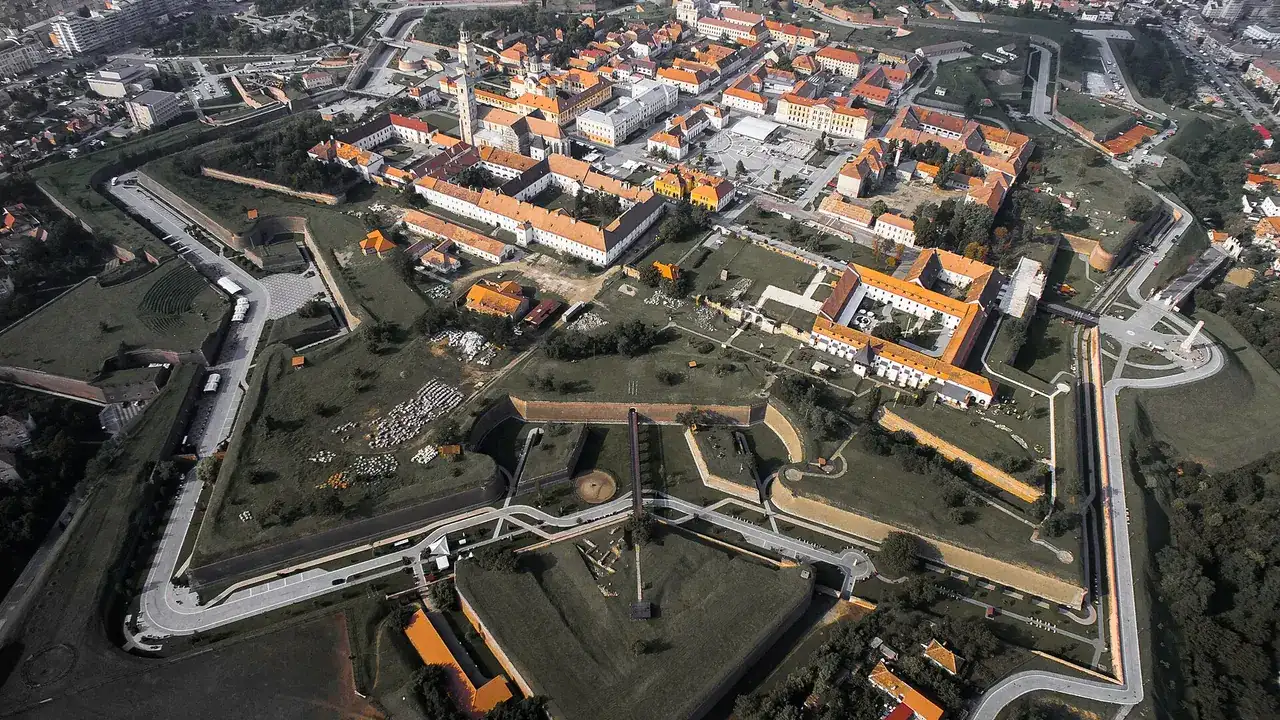
Alba Carolina in Alba Iulia is the largest citadel in Romania, a seven-pointed star fort that costs nothing to enter and never shuts. You’ll walk in through a baroque gate and find a working piece of town inside the ramparts: two cathedrals a few hundred metres apart, the headquarters of a Roman legion, museums, terraces, people carrying shopping home. The thing to get right is which day you come, because the changing of the guard has moved to Friday and Saturday evenings plus Sunday at noon, and don’t trust guidebooks that still print the old “every day at midday”.
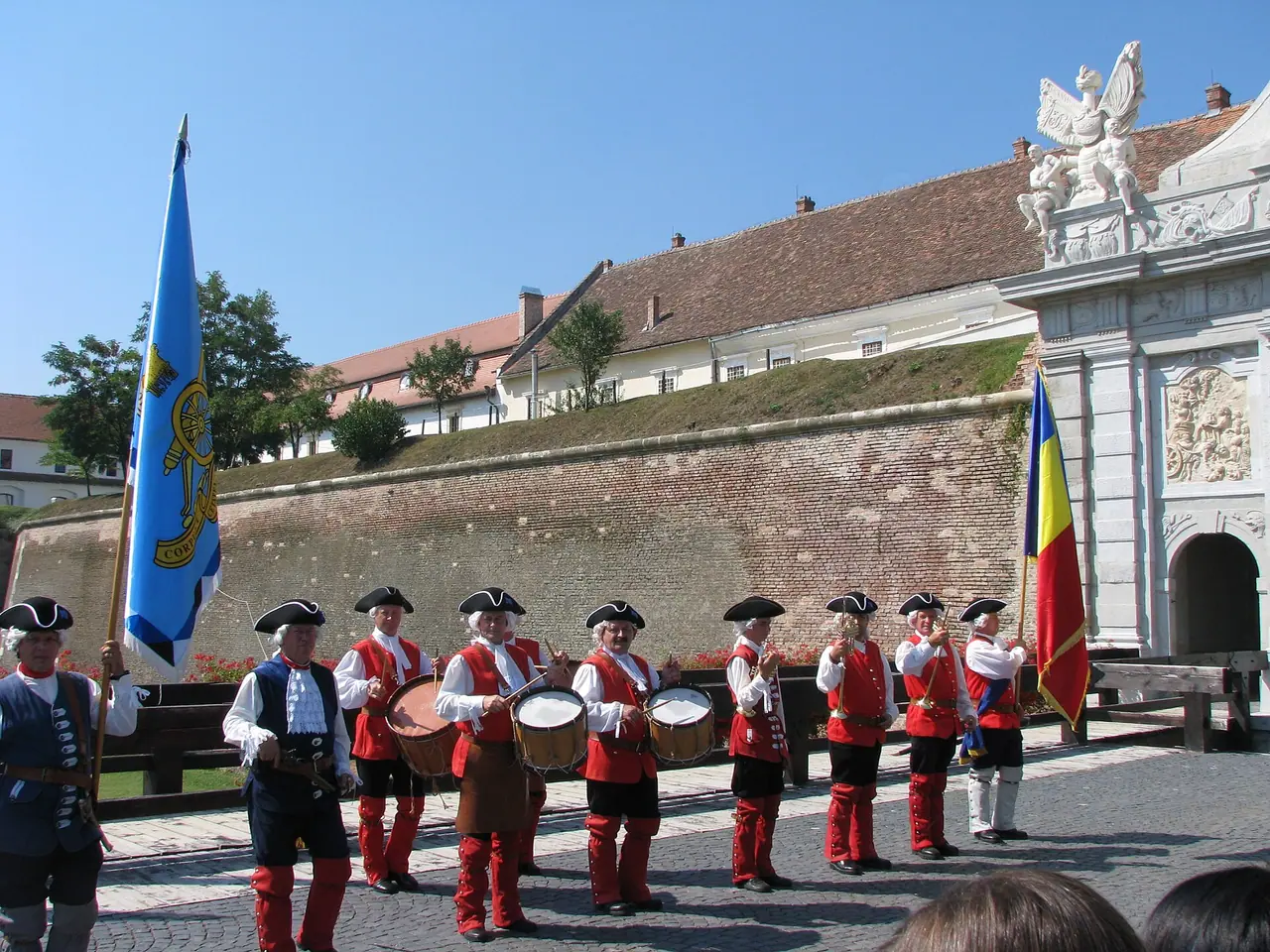
That single detail decides whether your visit is a quiet walk on grass or the show the place is known for. For the 2026 season, which runs from 1 May to 1 October, the Fortress Guard performs on Friday at 20:00 with the small guard of 12 soldiers, on Saturday at 20:00 with the large guard of 22 soldiers and four horses, closing with two cannon salvos, and on Sunday at noon with the small guard again. Come on a Tuesday and you get quiet ramparts and open museums. Come on a Saturday evening and you get drums, muskets and gunpowder smoke drifting over the ditch.
How big is it, and can you actually see the star?
The citadel went up between 1715 and 1738 under the Habsburgs, to a design by the Italian architect Giovanni Morando Visconti, who never saw it finished: he died of plague in 1717 while running the works, and lies buried here, in the Catholic cathedral inside the walls. The plan is a heptagon, a seven-cornered star with seven bastions, each face running 110 to 120 metres. The walls stand 10 to 12 metres high, the main ditch is 25 metres across, and the whole thing is laid out in three successive lines of defence. The city’s own heritage catalogue calls it the largest bastion citadel still standing in Romania and one of the largest in south-eastern Europe - that’s the scale you’re dealing with. Building it took the labour of some 20,000 serfs.
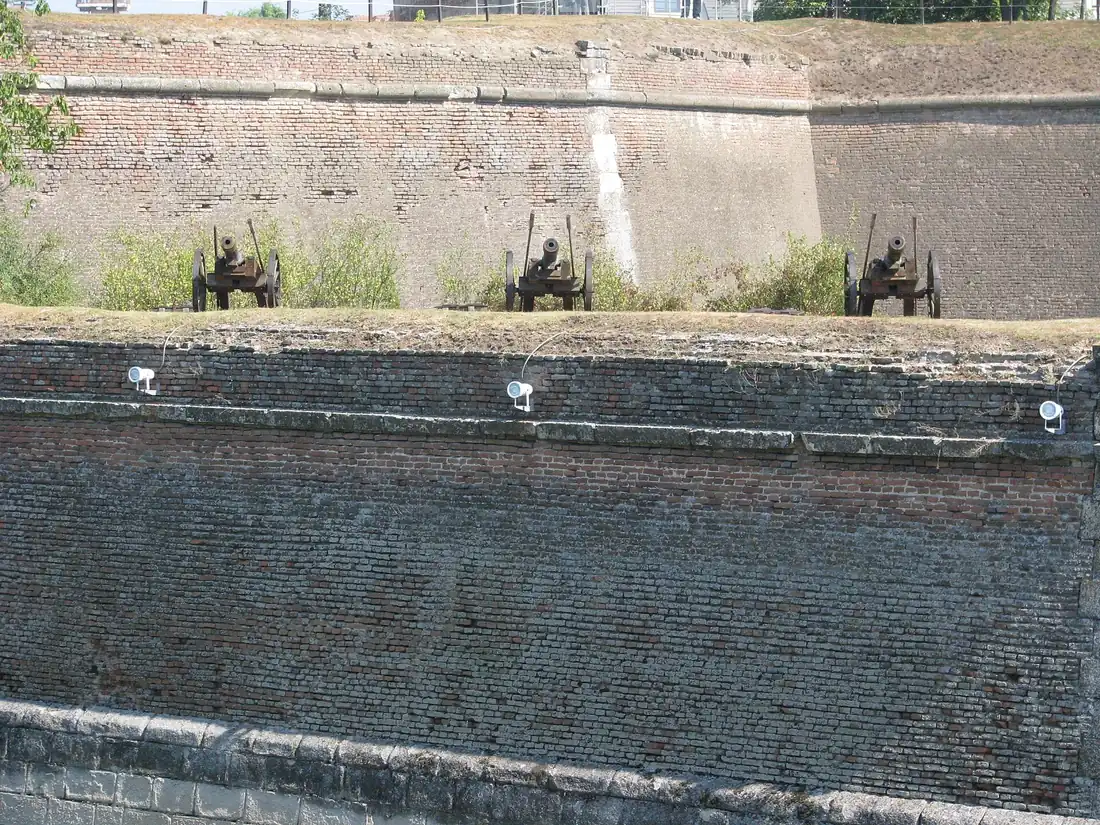
Here’s the part that photos hide: from the ground you never see the star. Every image that makes Alba Carolina famous, including the one at the top of this page, was taken from the air. At eye level you get long brick walls, grass banks and gateways, and the geometry only clicks when you drop into the outer ditch and walk it. Ten minutes down there and you can read the whole system: the wall in front of you folds away at an angle so that defenders on the next bastion could rake anyone standing where you are. That beats another lap of the pretty inner street.
Timing the guard change without getting burned
The ceremony is run by the Palatul Principilor cultural centre, happens in the open air on the esplanades by Gates III and IV, and the programme lists no separate ticket for it. What changes is the timetable, and it changes every single season: in 2025 the guard also turned out at midday on Saturday, and for 2026 that slot is gone, with the big performance and its cannon moved to the evening. Festival weeks add to the programme rather than replace it: over the Imagine Fest weekend in late July 2026 the guard kept its 20:00 slots while a Roman legion reenactment group filled the hour before on Saturday. If your trip hangs on seeing the large guard, check palatulprincipilor.ro a day or two ahead rather than trusting a schedule you read in spring.
One seasonal detail worth flagging. A 20:00 start in July is still broad daylight, so you get a clean look at the uniforms and the drill. By late September the same slot falls close to dusk, the muzzle flashes actually show, and the ramparts are colder at that hour than the afternoon suggests.
Gate III, the emperor’s arch and the works in progress
The main way in from the east is Gate III, and it’s the most theatrical piece of stonework in the citadel: a triumphal arch under the equestrian statue of Emperor Charles VI, built between 1715 and 1728. The carved panels tell you exactly what the Habsburgs wanted said. Eugene of Savoy is invested as commander of the army; Victory hands him a model of this very fortress; Christian cavalry charges; imperial infantry storms Ottoman guns.
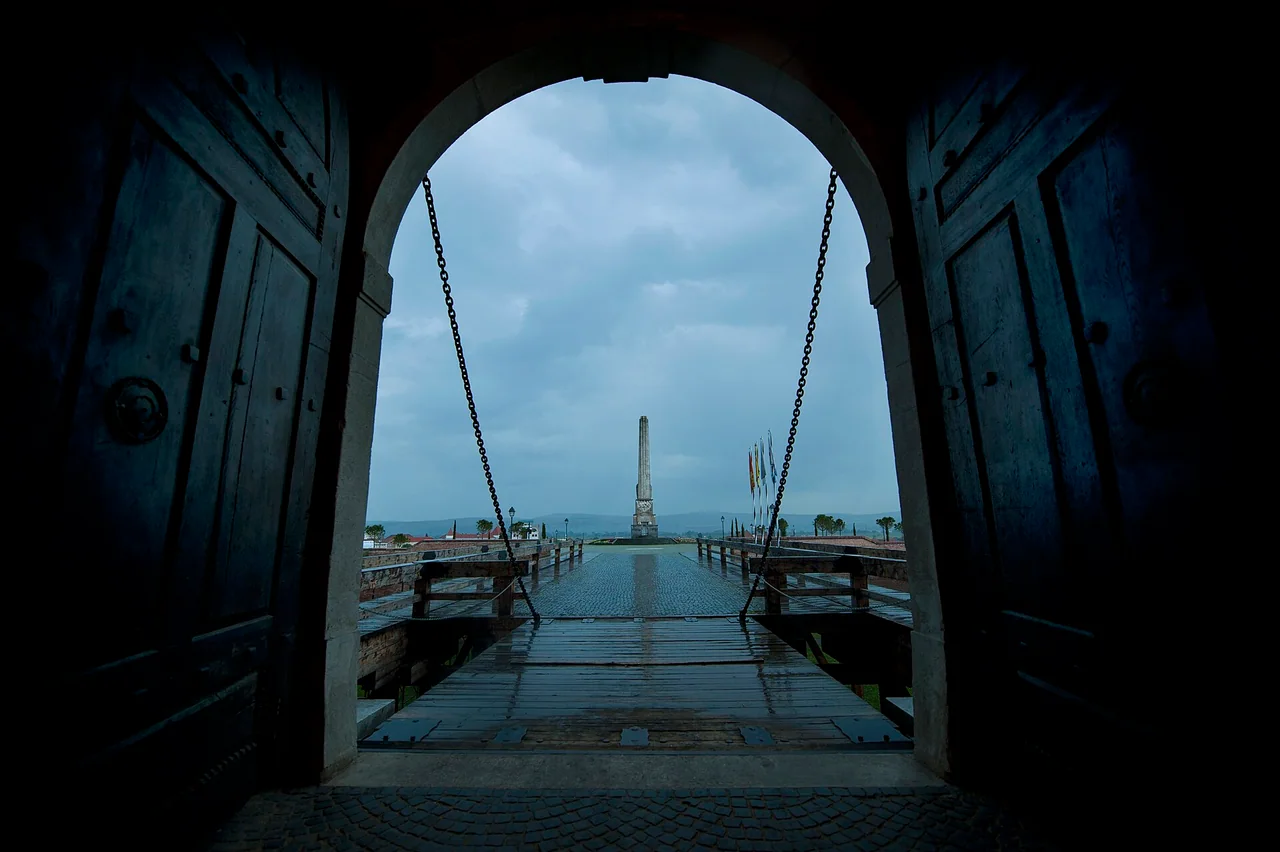
Under the statue there’s a small chamber that guides call Horea’s cell, after the leader of the 1784 peasant revolt. Treat it as a good story rather than a fact: historians point to Gate IV as the place where Horea was actually held, and the name attached itself to this room in 1937, when the obelisk to Horea, Closca and Crisan went up on the esplanade outside.
Now the practical warning. Four of the seven monumental gates are in a restoration programme worth about 1.9 million euros. Gate II was finished in October 2025 and Gate I reopened at the end of May 2026, but Gate III was roughly 70 per cent done in June 2026 with completion expected in 2027, and Gate IV is on the same timeline. Nobody publishes the closure dates, so the showpiece arch may be behind hoardings on the day you arrive: worth a check if you’re planning a photo around it. The eastern side is a building site too, with some 20,000 square metres of the outer ditch being turned into a park by 2027. Over 50 million euros of EU money has gone into this fortress since 2000, and there’s more coming.
Two cathedrals, nine centuries apart
The pair of churches inside the walls is the actual history lesson. St Michael’s Roman Catholic Cathedral is the oldest and the longest cathedral in Romania, 93 metres end to end, begun around 1004, wrecked in the Mongol invasion of 1242 and rebuilt at the close of the 13th century in a Romanesque shell with Gothic detailing. In the south aisle lies the sarcophagus of John Hunyadi, who died in 1456, alongside his son Ladislaus; in the north aisle are Queen Isabella and John Sigismund, the first prince of Transylvania. That’s the same Hunyadi family whose fortress at Hunedoara is the largest Gothic castle in Transylvania, and our Corvin Castle visiting guide covers the other half of that story.
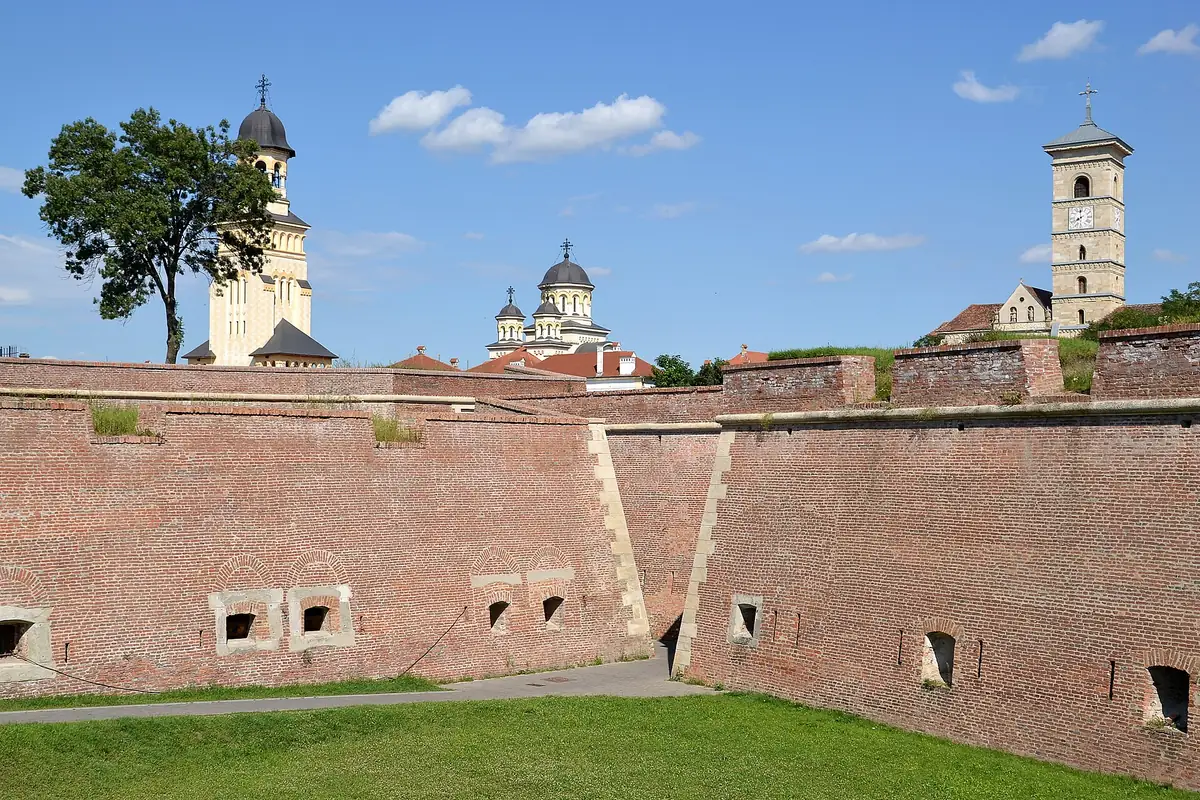
A few hundred metres away stands the Orthodox Coronation Cathedral, which went up in two years flat, 1921 to 1922, to plans by Victor Gheorghe Stefanescu. On 15 October 1922 Ferdinand I and Queen Marie were crowned here as sovereigns of Greater Romania. Its bell tower is 58 metres high, and part of the St Michael bastion and its ravelin were demolished to clear the ground for it. Both cathedrals are free to enter, though times vary with services, so don’t trust online hours - check on the door.
Which museum ticket is worth buying
Entry to the citadel costs nothing. Everything with a roof charges, and the prices are low by Western standards. At the National Museum of the Union, in the thick-walled Babilon building, an adult ticket is 20 lei; the exhibition inside the Union Hall is 15, Museikon with its icon collection 10, the ethnographic centre 5. Combined tickets are the sensible move if you’re hitting more than one: museum plus Union Hall 25 lei, three venues 35, all four 40. A guided tour of the museum and the Union Hall costs 100 lei, a guided walk of the fortification 150 lei an hour, worth splitting across a group.
Hours are seasonal, which trips people up in autumn. From May to August these venues run 10:00 to 18:00 with the ticket desk closing at 17:30; from September to April they shut at 17:00, with Tuesday closed as well in January and February. Don’t assume late entry - check mnuai.ro if a late arrival is your plan. Museum tickets can be booked online, but Principia has been a cash desk, so carry some lei anyway.
Two more sites sit under the Palatul Principilor cultural centre. The Palace of the Princes museum, open since 2023, runs daily 09:00 to 19:00 from 1 May to 30 September and 09:00 to 17:00 in winter. Next to it, Principia preserves part of the headquarters of the 13th Gemina legion in situ under the Habsburg town, so you stand on the Roman layer instead of reading about it. Its ticket is listed at 10 lei for adults, Tuesday to Sunday, but I couldn’t confirm that from the operator, so treat it as an estimate and check palatulprincipilor.ro.
The one to plan properly is the Batthyaneum library, which holds the Codex Aureus, a gospel book written in gold ink around the year 810. You can’t simply walk in: access runs through a written request at least three days ahead, approved by the National Library of Romania, and even then you see the Aula Magna and the exhibition room rather than the stacks. People turn up at the door expecting a museum and leave disappointed.
One blunt scheduling rule follows: Monday is a walls-and-cathedrals day, since the museum venues shut. If that’s your only slot, spend it in the ditch and the churches and drop the museum plan.
Why Alba Iulia is the capital of the Great Union
On 1 December 1918, in the hall of the old military casino inside these walls, 1,228 elected delegates voted the resolution that united Transylvania, Banat, Crisana and Maramures with the Kingdom of Romania, while something like 100,000 people gathered on the field outside. That hall is now the Union Hall, the busts of the delegates line the alley in front of it, and 1 December is Romania’s national day. Arrive on that date and you get the ceremony of a lifetime and no chance of a hotel room, a parking space or a quiet photograph. The parade also runs in Bucharest the same day, so if you’re choosing between the two, our Romania events calendar lays out what each version actually looks like.
Getting to Alba Iulia, and the train trap
Alba Iulia sits in the middle of Transylvania and is easiest to reach by road. From Sibiu it’s about 75 km and roughly an hour by car on the motorway corridor to Sebes, with around 20 minibus departures a day taking about an hour and twenty minutes. The train is the trap on this leg: one or two direct services a day, two and a half to three hours for 92 km, and they don’t run every day, so check the date on infofer.ro. From Cluj-Napoca it’s about 100 km on the A10 motorway, one hour twenty to one hour forty by car, and 2 h 15 to 2 h 50 by train. Bucharest has one or two direct trains a day, plus long-distance services from Budapest and Vienna.
The station sits on the south side of town, about 1.5 km out: a flat 15-minute walk to the southern entrance of the citadel, 25 to 30 minutes to the main square inside. Check current times on infofer.ro rather than any list printed here. If you’re stringing several Transylvanian towns together, our Transylvania road trip route shows where Alba Iulia fits between Sibiu and the western castles, and the Sibiu travel guide covers the obvious base for a day trip here.
How long to give it, and what to pair it with
Half a day covers the ditch walk, one cathedral and one museum at a civilised pace; two hours is enough if you’re passing through and only want the ramparts and Gate III. A full day makes sense only if you’re staying for the evening guard change, and in that case book a bed in town rather than gambling on a late bus back to Sibiu.
The natural pairing is westward, with Hunedoara and Corvin Castle an easy leg away on the same loop. That contrast is why Alba Carolina sits where it does in our ranking of Romania’s castles: the biggest fortification in the country, free to walk, but a fortified town rather than a castle with furnished rooms. Come for the scale and the geometry, and spend what you saved on the museums.
Photos
On the map
The map loads on click - to keep the page lightweight.
The map didn’t load. Check your connection and refresh the page.
Admission and opening hours
- Admission price
- The citadel itself is free and open at all hours. Museums charge: National Museum of the Union 20 lei, the Union Hall exhibition 15 lei, Museikon 10 lei; combined tickets 25-40 lei; guided tour of the citadel 150 lei per hour. Students and pensioners pay half, children roughly a quarter; preschoolers, war veterans and visitors with disabilities go free (mnuai.ro).
- Opening hours
- Walls and streets open around the clock. Museum of the Union, Union Hall and Museikon: closed Monday (in January and February closed Tuesday too); Tuesday to Sunday 10:00-18:00 from May to August, with the ticket desk closing at 17:30, and 10:00-17:00 from September to April.
The guard-change programme is seasonal and changes every year; in 2026 it runs 1 May - 1 October, Friday and Saturday at 20:00 and Sunday at 12:00. Prices and hours change: confirm on mnuai.ro and palatulprincipilor.ro before you go.
Details checked: July 31, 2026
Distance ≈100 km · 1 h 20 - 1 h 40 by car on the A10; trains about 2 h 15 - 2 h 50
- Cluj-Napoca ≈100 km · 1 h 20 - 1 h 40 by car on the A10; trains about 2 h 15 - 2 h 50
Read also

What to see · 11 min read
Marginimea Sibiului: Shepherd Villages Near Sibiu
Verified · September 5, 202618 shepherd villages west of Sibiu: Rasinari, Sibiel glass icons, Saliste, Paltinis bus fares, and how a day out of town works.

What to see · 9 min read
Prejmer Fortified Church: UNESCO Near Brasov
Verified · September 3, 2026Prejmer fortified church 15 km from Brasov: Greek-cross plan, 275 wall rooms, UNESCO hours for 2026 and how a visit actually works.

What to see · 11 min read
ASTRA Museum Sibiu: Romania's Great Open-Air Village
Verified · August 29, 2026ASTRA Museum near Sibiu: 50-lei tickets, hours by season, how to get there, and which of the 400+ buildings across 96 hectares to see first.

What to see · 10 min read
Bucegi Sphinx & Babele: Cable Car from Busteni
Updated · August 26, 2026Ride the Busteni cable car to the Sphinx and Babele: 2026 return fare 199 lei, hours from 08:30, and how to pair it with Peles or Cantacuzino.