
Snagov Monastery: Vlad the Impaler's Reputed Grave
Snagov Monastery on Lake Snagov: the slab said to mark Vlad's grave, what the 1933 dig found, plus the 2009 footbridge, hours and boat.
Snagov Monastery sits on a wooded island in Lake Snagov, about 40 km north of Bucharest. The Archdiocese of Bucharest still presents a stone slab in front of the altar as Vlad the Impaler’s tombstone. When archaeologist Dinu Rosetti dug under that slab in 1933, he found no grave at all - a prehistoric pit with animal bones, including horse jaws. You walk onto the island on a pedestrian footbridge finished in 2009-2010; the boat ride is optional, not the way in.
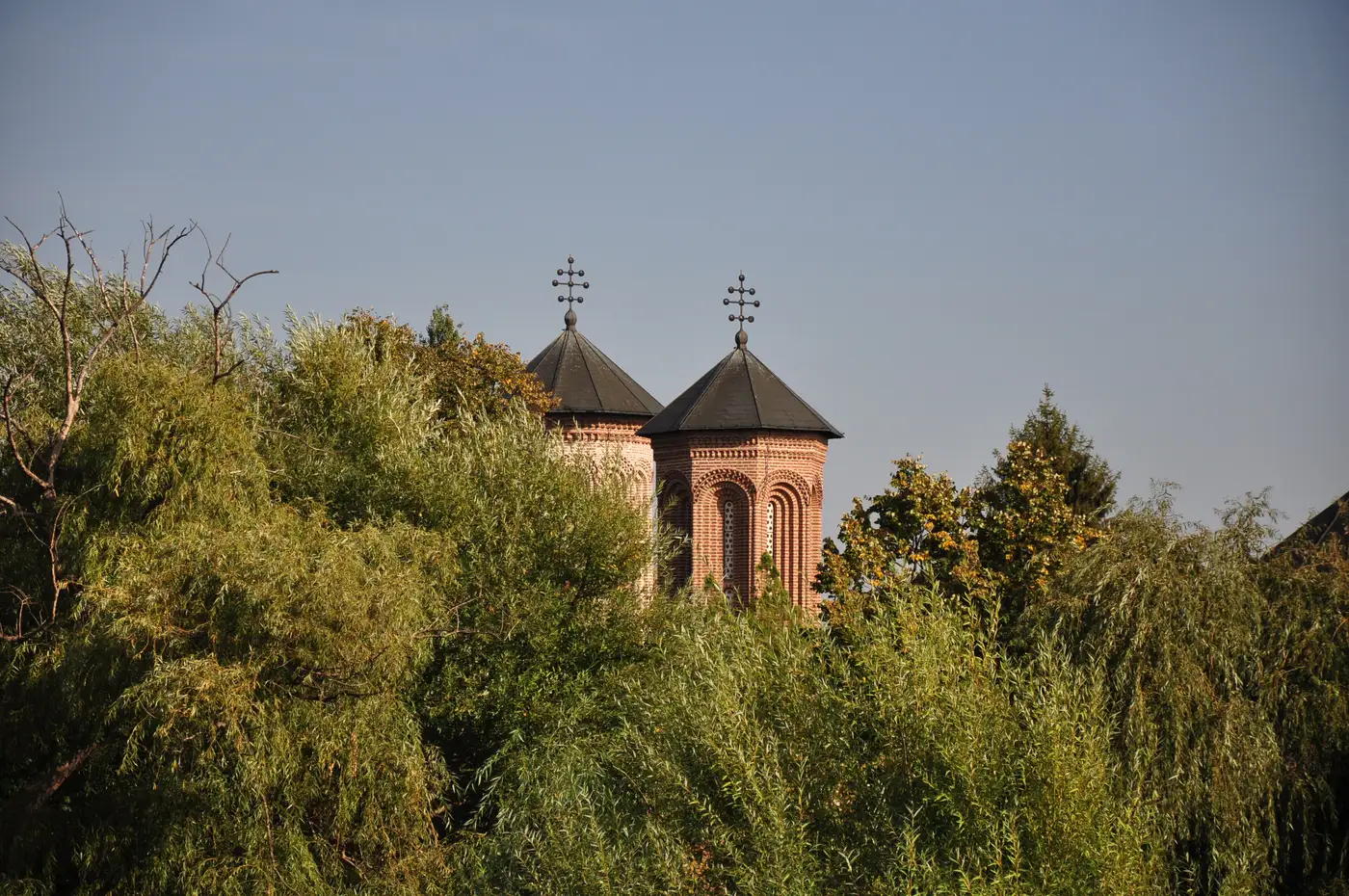
That gap between the plaque and the dig is why the place is worth the drive. The church you actually stand in was raised by Neagoe Basarab between 1517 and 1521, decades after Vlad was killed in 1476, so even the building isn’t “his”. What you get is a quiet brick monastery on roughly four hectares of island, a contested slab, and a half-day that most castle itineraries skip because it doesn’t look like a fortress on a crag.
The stone in front of the altar
Hold the two claims apart, because they’re not the same sentence.
The church’s own line is unambiguous. On the Archdiocese of Bucharest page for the monastery, the sentence runs: in front of the altar lies the tombstone of voivode Vlad Tepes. Local tradition, which Alexandru Odobescu wrote down in the 1850s and Nicolae Iorga repeated later, says monks recovered his body after the 1476 battle and buried it quietly once the new Danesti prince was in place. Ottoman sources say his head was taken to Constantinople and displayed on a stake; they’re silent about the rest of him. So the slab is a statement of belief, not a lab result.
The archaeology is also unambiguous, and it points the other way. Dinu V. Rosetti excavated inside the church from June to October 1933 and published the work in 1935. Under the stone attributed to Vlad he found no tomb. He described a prehistoric pit, ceramics, and “many bones and jaws of horses”. Forty years later, in 1973, Rosetti floated a later hypothesis that an anonymous grave near the entrance might be Vlad’s. That second idea had no inscription and no objects that survived later museum losses; historian Constantin Rezachevici, writing in the Journal of Dracula Studies in 2002, treats it as a guess piled on a negative dig.
Rezachevici’s own candidate is Comana Monastery, a foundation of Vlad’s from 1461, south of Bucharest rather than north. Digs in 1971 and 1972 traced the first church and found an unidentified grave where a founder would lie, with no tombstone on it. Rezachevici calls it the likeliest candidate; that’s an argument, not a body. The first church at Comana is gone, so that claim is also unproven. Bucharest therefore has two rival “Dracula graves” on opposite sides of the ring road, and neither has a body you can point to.
If you came for the man rather than the slab, the sites that actually belonged to him sit elsewhere: Poenari Castle is the fortress he held, and Targoviste is the capital he ruled from. Snagov is the story people tell about the ending.
A brick church built after he died
Once you stop hunting for a coffin, the island has a real history that doesn’t need one.
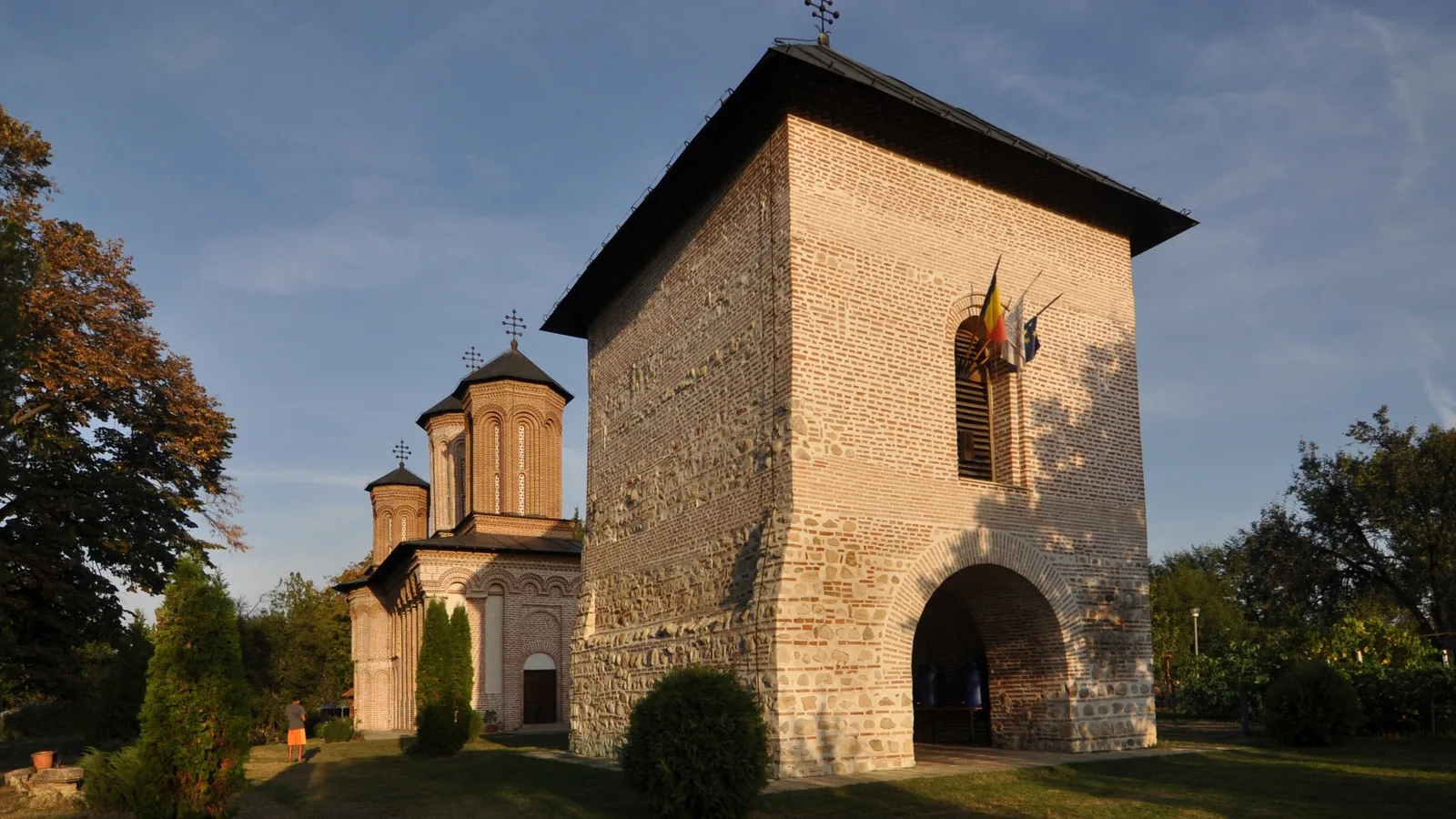
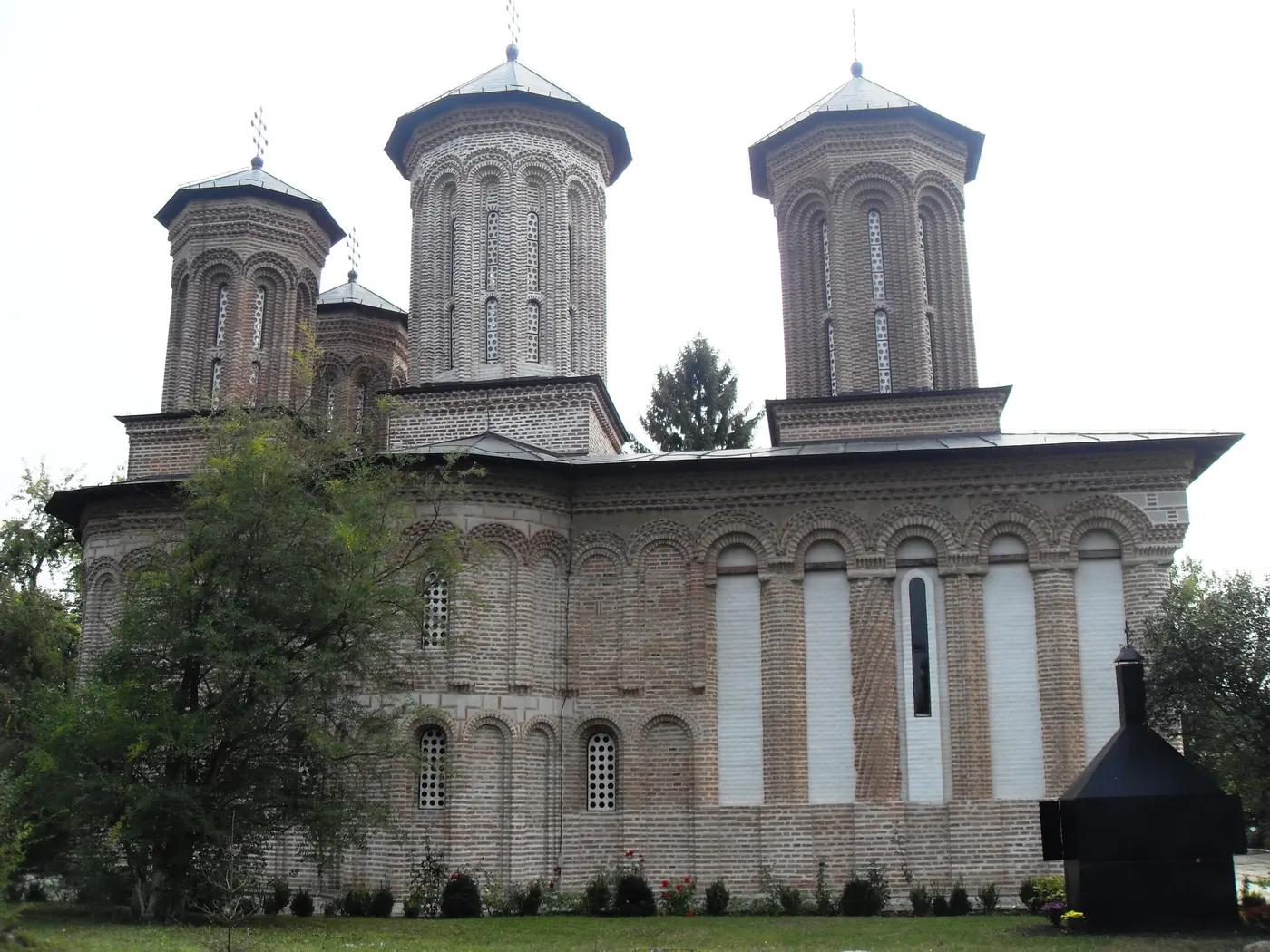
The Archdiocese dates a monastic settlement here to the time of Mircea the Elder, with a first written mention in 1408. Around 1456, tradition credits Vlad with a defensive wall, a wooden bridge, a prison for traitors and a refuge tunnel under the water. Treat that list as tradition: the same page that records it also admits the tunnel is ruined, and nobody walking the island today is shown a working passage. What you can still see is the church Neagoe Basarab built in 1517-1521, a triconch brick pile with two towers, plus a river-stone bell tower and a stone well behind the altar. The rest of the old precinct is gone or rebuilt.
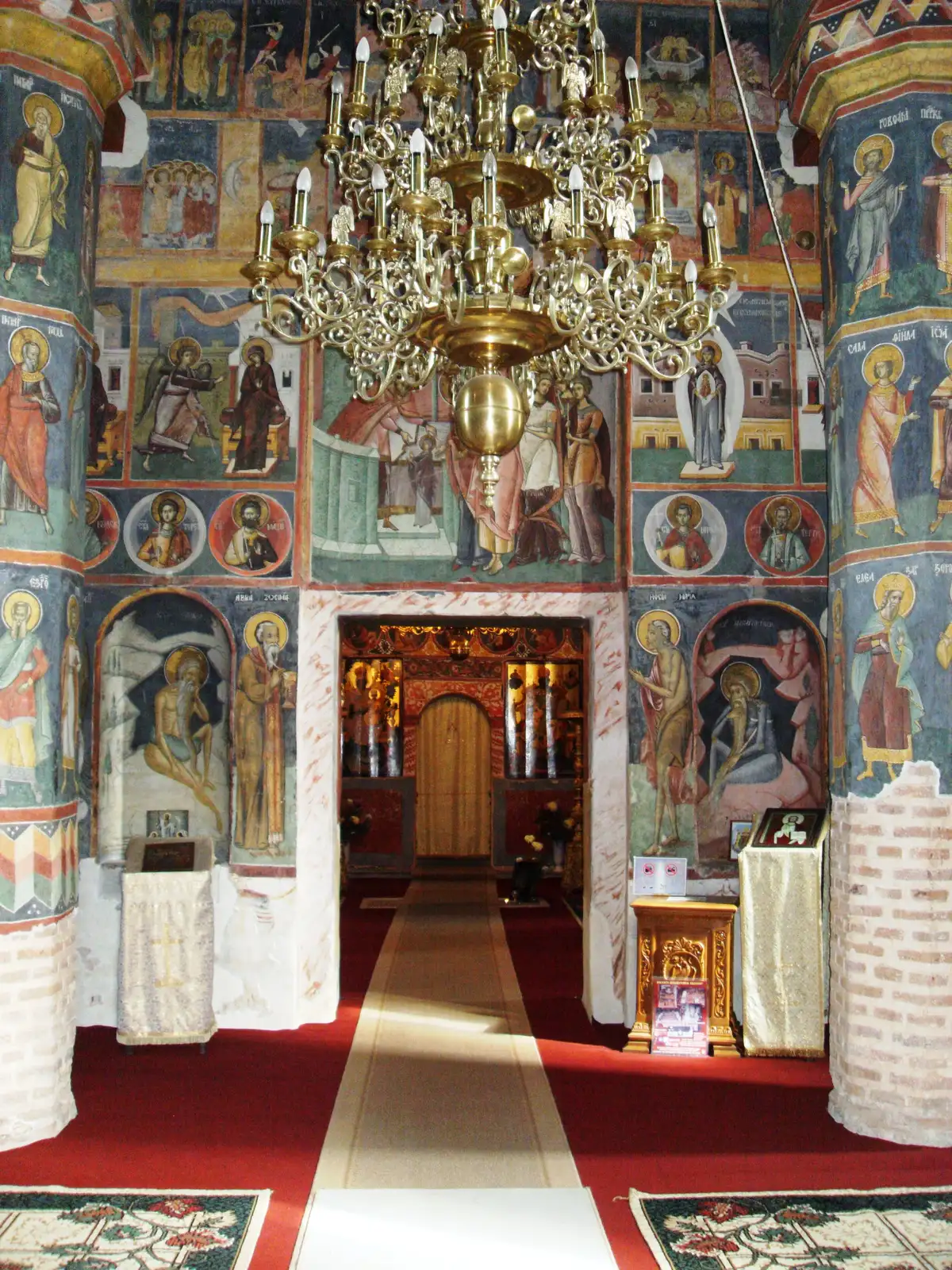
The frescoes are the other reason to go inside. Dobromir the Young painted the church in 1563, under Petru cel Tanar - Peter the Younger, son of Mircea Ciobanul; that layer survives in the narthex. The nave and altar were overpainted in 1815 by Gheorghe Zugravul. You’ll walk through two centuries of wall painting, not a vampire exhibit. In the 1690s the island was a printing shop as much as a monastery: Anthim the Iberian, abbot from 1694 to 1705, ran a press here that produced books in Romanian, Greek, Slavonic and Arabic, including an Arabic liturgikon in 1701. That’s a stranger, better story than a coffin, and it’s documented.
You walk across now
Older guides still send you looking for a boatman. You don’t need one.
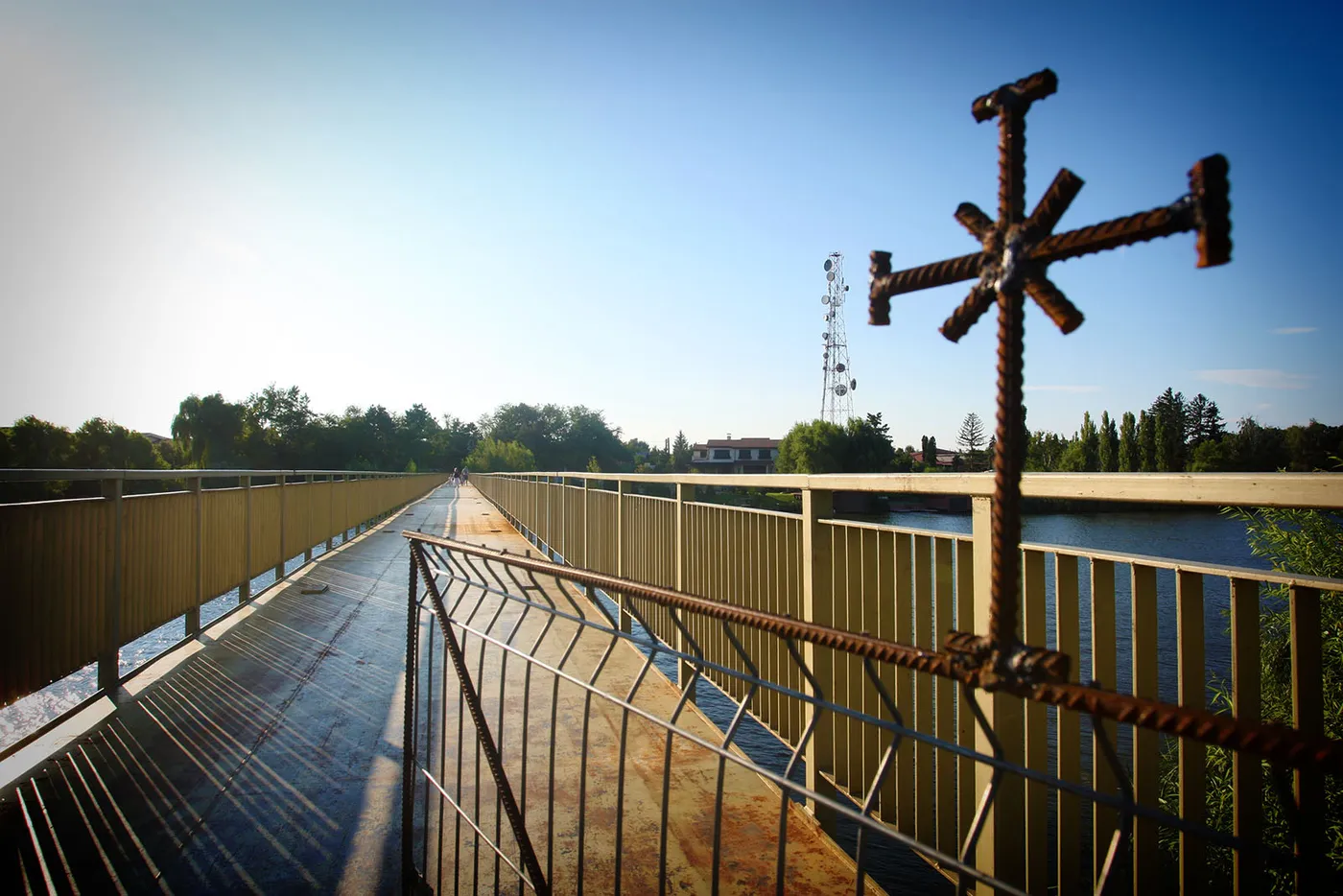
The oak bridge that once tied the island to the shore burned in 1821 and wasn’t rebuilt for nearly two centuries. Between 2009 and 2010, with the blessing of Patriarch Daniel, the Archdiocese put up a pedestrian walkway from the village of Silistea Snagovului. That’s the official access: you park or get off the bus, walk the metal span, and you’re on the island. It’s short, slightly rusty, and entirely unromantic, which is useful. You arrive as a visitor to a working monastery, not as a passenger in a legend.
A boat is still for sale if you want the lake, not the crossing. Fundatia Snagov, the local tourism operator, runs a vaporaș from Artha Park in Snagov village. As listed in August 2026, a 60-minute circuit is 75 lei (45 lei under 18), with fixed Saturday and Sunday departures at 12:00 and 17:00, and a minimum of seven paying passengers. The 90-minute version that actually stops at the island is 90 lei a head and runs on request. Reservation is required; the operator won’t pretend a boat leaves every half hour. From the village you can also book a round-trip hop to the island at about 50 lei, again on request. None of that replaces the footbridge. It’s a lake outing you can add if the weather is kind and the group exists.
Hours, 15 lei, and a door that may be locked
This is a monastery, not a ticketed castle, and it behaves like one.
The Archdiocese doesn’t publish a tourist timetable on its Snagov page (checked 17 August 2026). Fundatia Snagov, which is a local operator rather than the monastery itself, tells visitors to try 09:00 to 17:00 on ordinary days, and to expect liturgy on Sundays and feast days from 08:00 to 12:00. It also puts the chance of finding someone with a key on a weekday at about 60 percent. That’s an honest number. If you turn up at 16:30 on a Tuesday in February, you may photograph the exterior and walk the island loop and never get inside.
The same operator lists a 15 lei visiting fee when services aren’t on, usually waived or not collected during Sunday morning liturgy. The Archdiocese doesn’t post that tariff. Pay what’s asked at the door, carry cash in lei, and don’t treat 15 lei as a locked-in museum price. A tourism listing on laculsnagov.ro gives a split schedule with a midday break (roughly 07:30-13:00 and 14:30-18:00 on weekdays, shorter on Saturday). Treat that as a listing, not as the monastery’s own hours, and still leave slack in the day.
Dress as you would for any Orthodox church: covered shoulders, no shorts that stop above the knee. Photography rules inside are set on the spot and aren’t published as a public tariff I could verify, so ask before you raise a camera in the nave.
Getting there from Bucharest
The island is in Ilfov, not in Transylvania, which is the practical fact most Dracula maps bury. You’re going north of the capital, past the airport belt, to a village on the north-west arm of the lake.
Driving is the clean option: about 40 km, typically 40 to 50 minutes from the centre if DN1 is moving, longer on a Friday evening. Follow signs toward Silistea Snagovului / Gruiu rather than toward the resort strip of Snagov village on the opposite shore; the footbridge is on the Silistea side. There’s informal parking by the lake at the end of the road. A booked car from the city makes sense if you’re a group, if you’re pairing this with Therme at Balotesti on the same corridor, or if you don’t want to decode the last village lane. Book a fixed-price transfer from your Bucharest hotel if you’d rather not drive; KiwiTaxi has a live Bucharest page, not a dedicated Snagov slug, and the drop-off is an address.
Public transport exists and is slow. STB line 446 runs from Piața Presei Libere out to Gruiu-Lipia and stops at Manastirea Vlad Tepes, which is the stop you want. The line is on the official STB list. A metropolitan 90-minute ticket is 3 lei (stbsa.ro/tarife, checked August 2026). The ride is well over an hour, frequencies thin out at weekends, and you still walk from the stop to the bridge. Check the live Info TB app the morning you go rather than a blog timetable. From Snagov village on the opposite shore you either drive around or book the vaporaș - don’t treat the village and the monastery as a short walk.
Don’t confuse this with a Bran Castle day. Bran is 170 km from Bucharest and wants a car or a night in Brasov. Snagov is a northern half-day, which is why it sits in our day trips from Bucharest list next to Mogosoaia and Comana, not next to the Transylvanian fortresses.
If you’ve a morning north of the city
Give the island 90 minutes to two hours, not a full day. Walk the footbridge, see whether the church is open, look at the slab if it is, walk the short circuit through the trees, and leave. The island’s small. Stretching it into an afternoon usually means sitting in a lakeside restaurant you didn’t come for.
The honest pairing is other Wallachian half-days, not a castle circuit. Comana, 40 km south, is the rival grave and a wetland park; Mogosoaia palace is 15 km out and a much easier add-on if you only have a car for a morning. Therme Bucharest sits on the same DN1 corridor at Balotesti, so a monastery-then-pools day is geographically tidy even if it’s tonally odd. If you still want the warlord rather than the ending, save a separate day for Poenari and Targoviste, which is the trip our Dracula in Romania guide is built around.
What you shouldn’t do is fold Snagov into a “Dracula’s castle” morning and expect the same show. There are no souvenir fangs at the gate, no timed tickets, and no Queen Marie interiors. You came to an island church that claims a grave the 1933 dig didn’t find. Held to that standard, the visit is short, specific and better than the caption on the map.
Photos
On the map
The map loads on click - to keep the page lightweight.
The map didn’t load. Check your connection and refresh the page.
Admission and opening hours
- Admission price
- 15 lei per person listed by Fundatia Snagov when services are not on (usually Sunday 08:00-12:00). The Archdiocese does not publish a tourist tariff - pay and confirm at the door.
- Opening hours
- The monastery does not publish tourist hours. Local operator Fundatia Snagov: Sunday and feast days 08:00-12:00 for liturgy; other days try 09:00-17:00, with a real chance the door is locked. Confirm on the day.
You walk in on the 2009-2010 pedestrian footbridge from Silistea Snagovului. A boat is optional, not required. Hours and the 15 lei are not posted by the Archdiocese. Checked 17 Aug 2026.
Details checked: August 17, 2026
Read also

What to see · 11 min read
Marginimea Sibiului: Shepherd Villages Near Sibiu
Verified · September 5, 202618 shepherd villages west of Sibiu: Rasinari, Sibiel glass icons, Saliste, Paltinis bus fares, and how a day out of town works.

What to see · 9 min read
Prejmer Fortified Church: UNESCO Near Brasov
Verified · September 3, 2026Prejmer fortified church 15 km from Brasov: Greek-cross plan, 275 wall rooms, UNESCO hours for 2026 and how a visit actually works.

What to see · 11 min read
ASTRA Museum Sibiu: Romania's Great Open-Air Village
Verified · August 29, 2026ASTRA Museum near Sibiu: 50-lei tickets, hours by season, how to get there, and which of the 400+ buildings across 96 hectares to see first.

What to see · 10 min read
Bucegi Sphinx & Babele: Cable Car from Busteni
Updated · August 26, 2026Ride the Busteni cable car to the Sphinx and Babele: 2026 return fare 199 lei, hours from 08:30, and how to pair it with Peles or Cantacuzino.