
Salina Turda: Visiting the Salt Mine
Salina Turda salt mine near Cluj: real ticket prices in lei, opening hours, how to get there from Cluj-Napoca, and what the underground park is like.
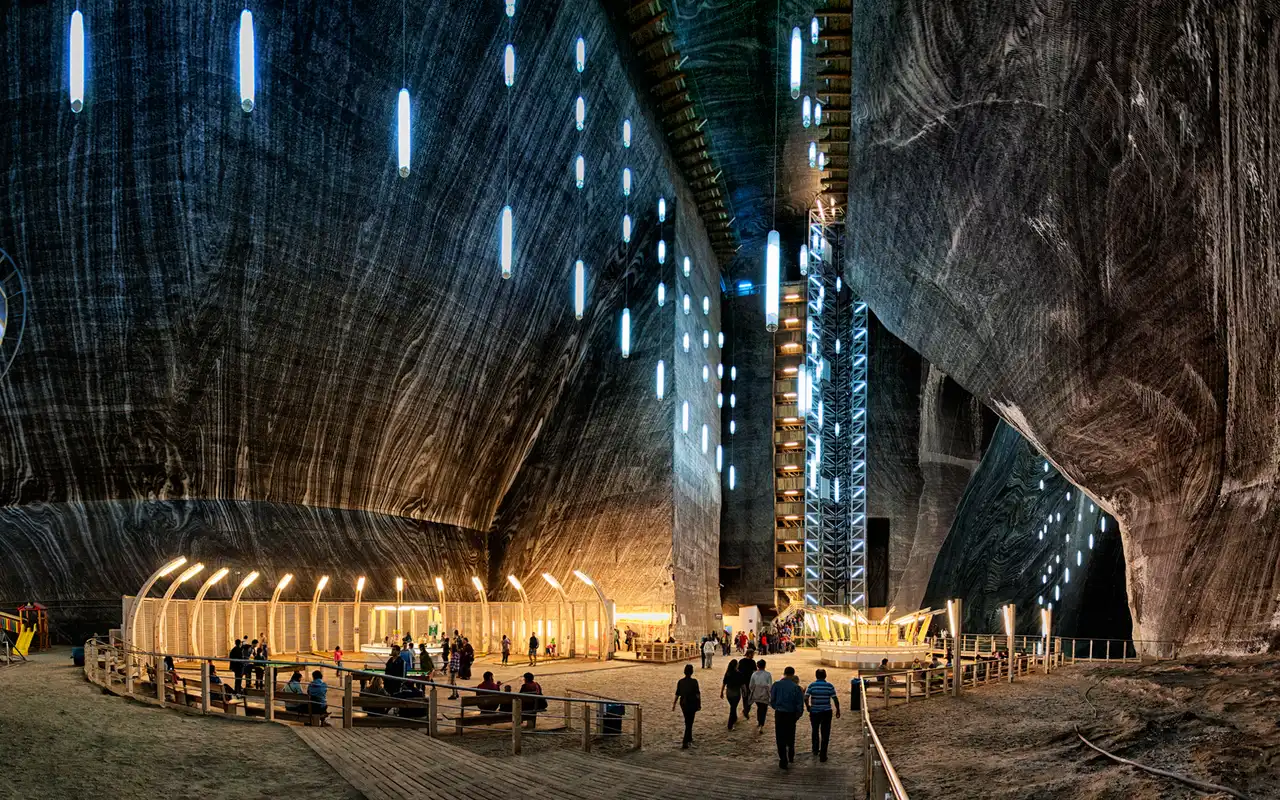
Salina Turda is a 250-year-old salt mine that someone turned into a subterranean theme park, and it’s the strangest attraction in Romania: 120 metres underground you step out into a colossal salt cavern with a Ferris wheel, an amphitheatre, a mini-golf course and a boating lake, all lit by ghostly hanging light tubes. It sits just outside the town of Turda, about 30 km south-east of Cluj-Napoca, adult tickets run 75 to 90 lei, and it’s open every day. Set your expectations right and it is genuinely unforgettable; walk in expecting a natural cave and you’ll be confused.
This is a hand-dug industrial mine, not a limestone cavern with stalactites, and the whole spectacle is the contrast between raw 18th-century mining scars and a slick modern light show bolted inside them. Go on a weekday if you can, both to save money and to dodge the crowds; take the bus or drive from Cluj; and bring a jacket, because it is a steady 12 degrees down there whatever the weather does on the surface.
What actually is Salina Turda?
A working salt mine that stopped working and got a second life. People dug salt out of this hill from Roman times, with continuous extraction from the Middle Ages onwards; the first written record dates to 1 May 1271. Industrial mining finally wound down in 1932, after which the tunnels sat mostly idle. During the Second World War the town used the cool, stable galleries as an air-raid shelter, and afterwards, oddly, as a cheese-storage depot. In 1992 it reopened as a halotherapy centre, and a big EU-funded modernisation between 2008 and 2010 (roughly 5.9 million euro) turned it into the tourist site you visit today.
That history is the key to enjoying it. What you’re walking through are the actual chambers the salt was cut from, some of them vast, and the designers left the raw walls exactly as the miners left them: grey and black stripes of rock salt, curtain-like folds where the seam buckled, and in places salt stalactites hanging up to three metres long. Then they hung the whole thing with those luminous vertical tubes and dropped a fairground into the bottom. It should feel tacky and somehow doesn’t; the scale of the caverns swallows the gimmicks and the effect lands somewhere between a cathedral and a sci-fi film set. Business Insider once put it on a list of the most spectacular underground places on the planet, and for once the hype is fair.
What is down there, chamber by chamber?
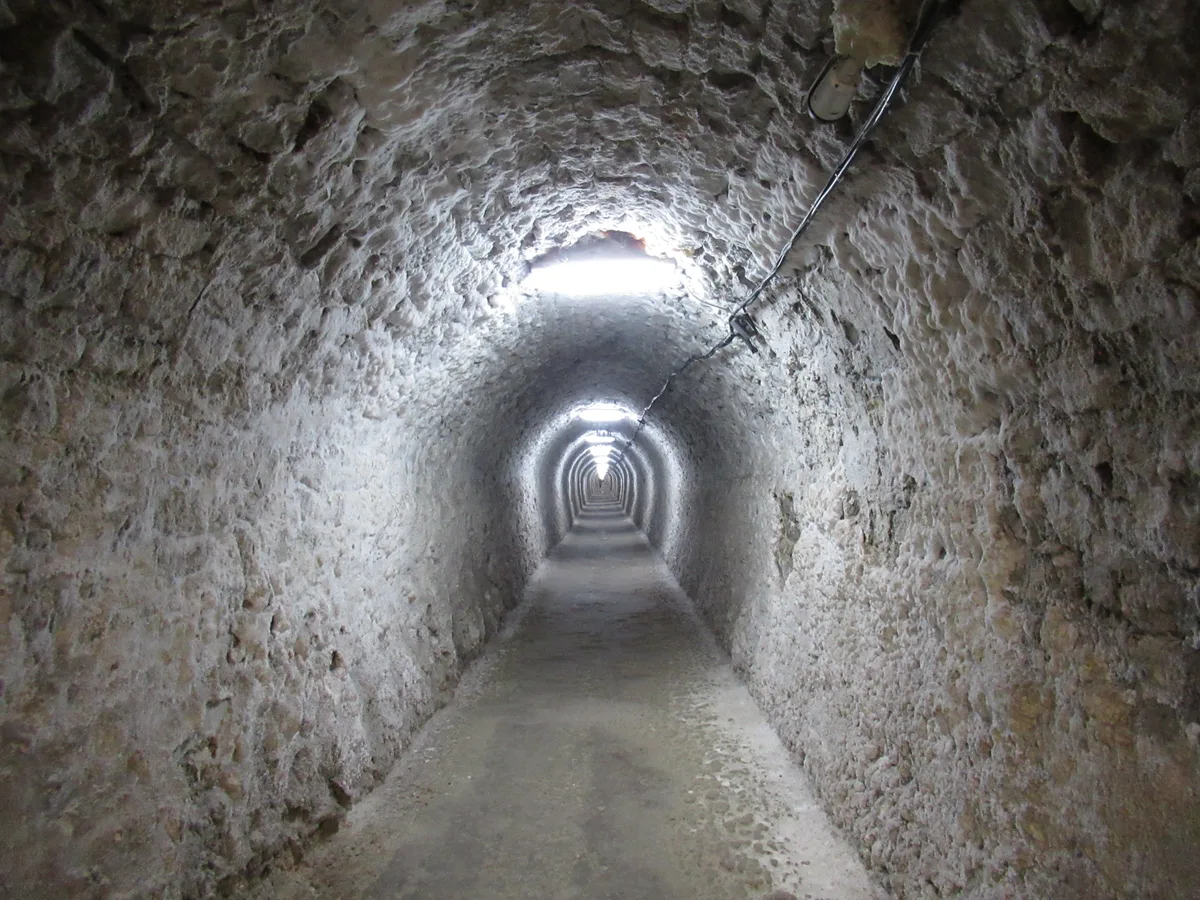
You enter along the Franz Josef gallery, a long horizontal tunnel hacked through the salt between 1853 and 1870 to drain and ventilate the mine. It is a good slow warm-up: a few hundred metres of rough, arched salt corridor with the occasional old timber and a faint salty taste in the air, and it makes the reveal at the end much better.
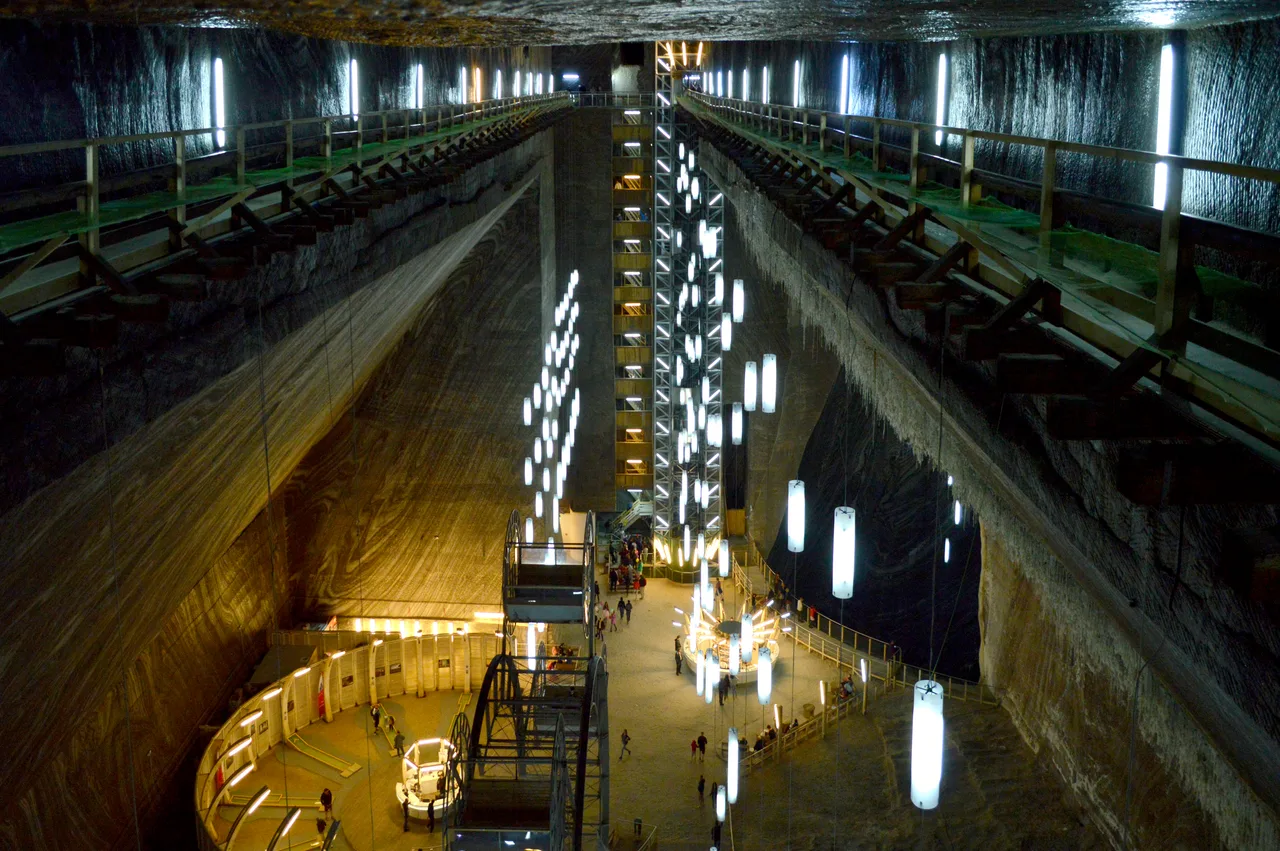
The showpiece is the Rudolf mine, the giant rectangular chamber at the heart of the visit, about 42 metres deep, 50 wide and 80 long. This is the one in every photo. Down on its floor sits the amusement park: a panorama wheel that turns slowly against the salt wall, a mini-golf course, billiard and table-tennis tables, a bowling lane, a children’s playground and an amphitheatre carved into the terraces. A wall of 172 wooden steps zigzags down one side, with 13 landings marked by the dates the levels were opened, and a glass panoramic lift runs beside it if your knees would rather not.
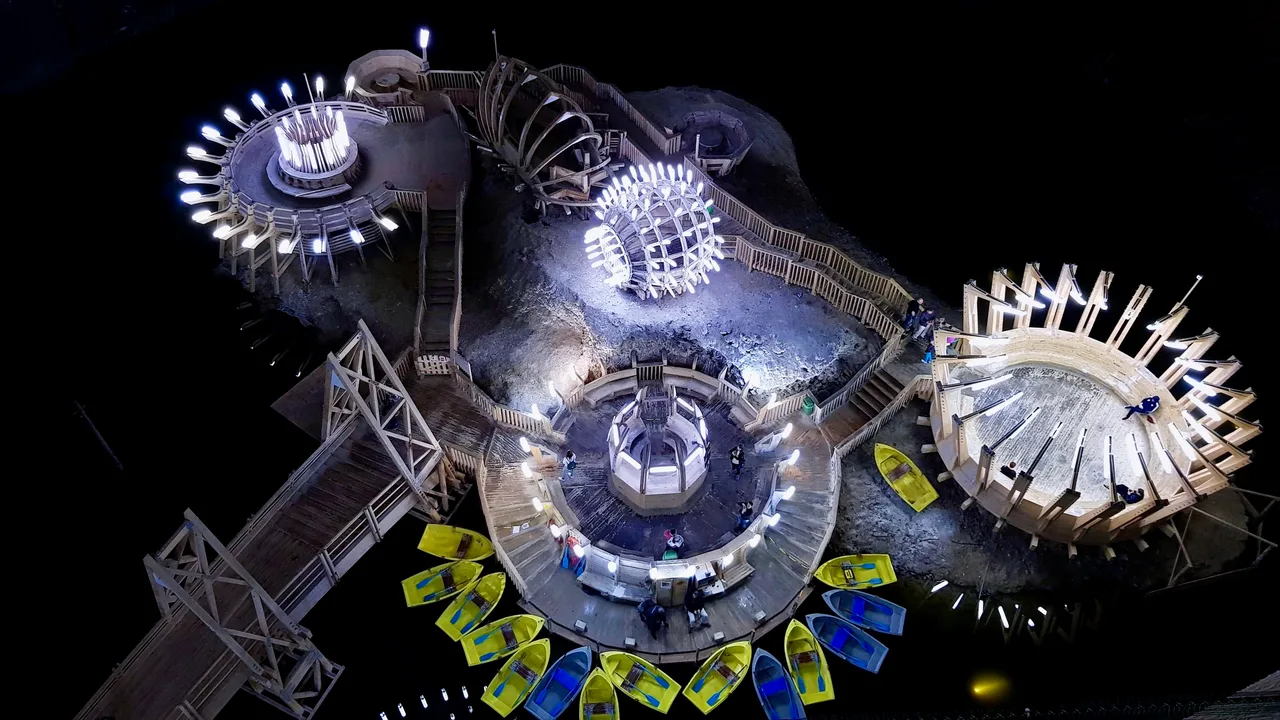
Then there’s the Terezia mine, a huge cone of a chamber with an underground salt lake covering most of its floor, up to eight metres deep, with a small salt island in the middle reached by a wooden bridge. You can hire a rowing boat and paddle around it, which is as surreal as it sounds. Nearby the Iosif mine, another tall cone, is nicknamed the Echoes Room for the acoustics; a clap or a word bounces around it for a startling length of time. All of this is reached on foot on wooden walkways, and the whole loop takes most people two to three hours.
How much are tickets, and what is the weekend catch?
A standard adult ticket is 75 lei on weekdays and 90 lei at weekends and on public holidays (checked September 2026 on the official site, salinaturda.eu). Seniors aged 65 and over pay 50 or 60 lei on the same split, and children aged 3 to 18 pay 48 or 59 lei; under-threes go free. That weekday-versus-weekend gap is the first thing to plan around, because it isn’t just about the money - weekends are also when the place is busiest with families from Cluj, so a weekday visit is cheaper and calmer at the same time.
The important small print is that most of the fun costs extra on top of entry. The base ticket gets you in and lets you walk everywhere, but the panorama wheel is about 35 lei a head, a rowing boat on the Terezia lake is around 56 lei per boat (up to three people, 20 minutes), mini-golf is roughly 35 lei, and the separate Ghizela mine is another 32 lei. None of it is essential - the caverns themselves are the attraction - but if you’re bringing kids who will want the wheel and a boat, budget for it. Groups over ten get one free ticket, and there’s a small paid car park on site. Prices creep up year to year, so treat the numbers here as a guide and confirm the current tariff.
Opening hours are simple: every day from 09:00 to 17:00, with the last entry at 16:20. There’s no closed day to trip you up, which is a relief after the Monday-and-Tuesday puzzle at Peles Castle. Come early if you want the big chambers to yourself for photos; the tour buses and the Cluj day-trippers tend to arrive from late morning.
How do you get to Salina Turda from Cluj-Napoca?
Turda is about 30 km south-east of Cluj-Napoca, and the cheapest way there’s the bus. Services run by the Fany company leave from the Pod Traian stop, just north of Piata Mihai Viteazu in the centre of Cluj, roughly every 20 to 30 minutes on weekdays (less often at weekends). The ride takes about 35 to 45 minutes and costs around 14 lei one way, paid to the driver. The catch is the last leg: the mine sits about 3 km north of Turda’s centre, so from the town you either take local bus number 17, grab a taxi, or face a 45-minute walk. Check the return times if a late afternoon is the plan, so you’re not stranded waiting for the last bus back to Cluj. For the full rundown of the bus, the local line 17, driving, taxis and transfers, see our guide to getting from Cluj to the Turda salt mine.
Driving is the easier option and turns Turda into a half-day rather than a logistical puzzle. From Cluj it is roughly 30 to 40 minutes on the A3 motorway and the DN, there is parking at the mine, and a car lets you tack on the nearby Turda Gorge without watching a timetable. Leave the driving out entirely and a fixed-price transfer from Cluj takes you door to door and waits for you, which makes sense for a family or a group splitting the cost. Cluj itself is the natural base for all of this, and it is worth a night or two in its own right - it is Transylvania’s liveliest city, with a big student scene and good food. Our Cluj-Napoca travel guide covers what to see and where to stay in the centre.
Is it worth it, and what should you know before going?
Yes, with a couple of caveats. This is not a natural cave, and if you have just been to a dripstone cavern you’ll find the “no stalactites, it’s a mine” reality jarring unless you know it going in. It can also feel more like an indoor family attraction than a wild-nature experience, especially on a busy weekend when the amphitheatre is full and the wheel is turning. But the sheer scale of the Rudolf and Terezia chambers is like nothing else, and the marriage of grimy mining history with the light installations genuinely stops people in their tracks.
Three practical things make or break the visit. First, dress for it: the temperature holds at about 12 degrees all year, so a heatwave in Cluj means you still want a jacket underground. Second, decide on the steps versus the lift - the 172 wooden stairs down into Rudolf are part of the fun on the way down but a slog back up, and the glass lift is there for anyone who would rather skip them. Third, there’s a reason some visitors linger for hours: the mine doubles as a halotherapy centre, and the salty, allergen-free air is sold as good for the lungs, which is why you will see people who have bought a multi-day pass sitting quietly on benches rather than queuing for the wheel.
What can you pair it with?
The obvious add-on is Turda Gorge (Cheile Turzii), a dramatic limestone canyon with walking trails a short drive from the town. It’s a natural reserve with a modest fee in season - 6 lei for adults from May to September, free the rest of the year, collected past the first bridge (checked August 2026) - and doing the gorge and the salt mine together makes a full, varied day out of Cluj - one underground and man-made, one above ground and wild. With your own car you can easily fit both; by bus it is trickier and you would likely pick one. If the choice is Turda versus another day out of Cluj, the day trips from Cluj page is the menu; this one stays on the mine.
If Salina Turda is part of a bigger Romania trip rather than a Cluj day out, it works as a northern extension to the classic Transylvania circuit. Most first-timers loop through the medieval towns and castles further south, and this is a natural add-on if you’re flying in or out of Cluj airport. Our Romania 7-day itinerary lays out that core loop through Brasov, Sibiu and the Transfagarasan, and it is easy to bolt a Cluj-and-Turda day onto either end. If you have longer, the 10-day Romania itinerary runs through Cluj on its way north to Maramures, which makes the mine a scheduled stop rather than a detour. For the headline sights on that route, the Bran Castle guide covers the “Dracula” castle everyone asks about, and things to do in Brasov sets up the best base for the mountains. Bring notes for the bus and the extras; the card machine at a salt-mine wheel isn’t something to count on. And dress for it rather than for the weather outside - the temperature down there takes no interest in which month you arrived.
Photos
On the map
The map loads on click - to keep the page lightweight.
The map didn’t load. Check your connection and refresh the page.
Admission and opening hours
- Admission price
- Adults 75 lei Mon-Fri / 90 lei weekends and holidays; seniors 65+ 50/60 lei; children 3-18 48/59 lei. Extras charged separately: Ghizela mine 32 lei, panorama wheel 35 lei, boats 56 lei/boat.
- Opening hours
- Open daily 09:00-17:00, last entry 16:20. Constant temperature around 12 C year-round.
Prices, hours and the extra-activity fees change - confirm on the official site (salinaturda.eu) before you go, and note weekend tickets cost more than weekdays.
Details checked: September 7, 2026
Read also

What to see · 11 min read
Marginimea Sibiului: Shepherd Villages Near Sibiu
Verified · September 5, 202618 shepherd villages west of Sibiu: Rasinari, Sibiel glass icons, Saliste, Paltinis bus fares, and how a day out of town works.

What to see · 9 min read
Prejmer Fortified Church: UNESCO Near Brasov
Verified · September 3, 2026Prejmer fortified church 15 km from Brasov: Greek-cross plan, 275 wall rooms, UNESCO hours for 2026 and how a visit actually works.

What to see · 11 min read
ASTRA Museum Sibiu: Romania's Great Open-Air Village
Verified · August 29, 2026ASTRA Museum near Sibiu: 50-lei tickets, hours by season, how to get there, and which of the 400+ buildings across 96 hectares to see first.

What to see · 10 min read
Bucegi Sphinx & Babele: Cable Car from Busteni
Updated · August 26, 2026Ride the Busteni cable car to the Sphinx and Babele: 2026 return fare 199 lei, hours from 08:30, and how to pair it with Peles or Cantacuzino.