
Pelisor Castle: Tickets, Hours & Queen Marie's Rooms
Pelisor Castle beside Peles: 30-lei tickets, 2026 opening hours, the autumn closure that catches people out, and how to fit both castles into one day.
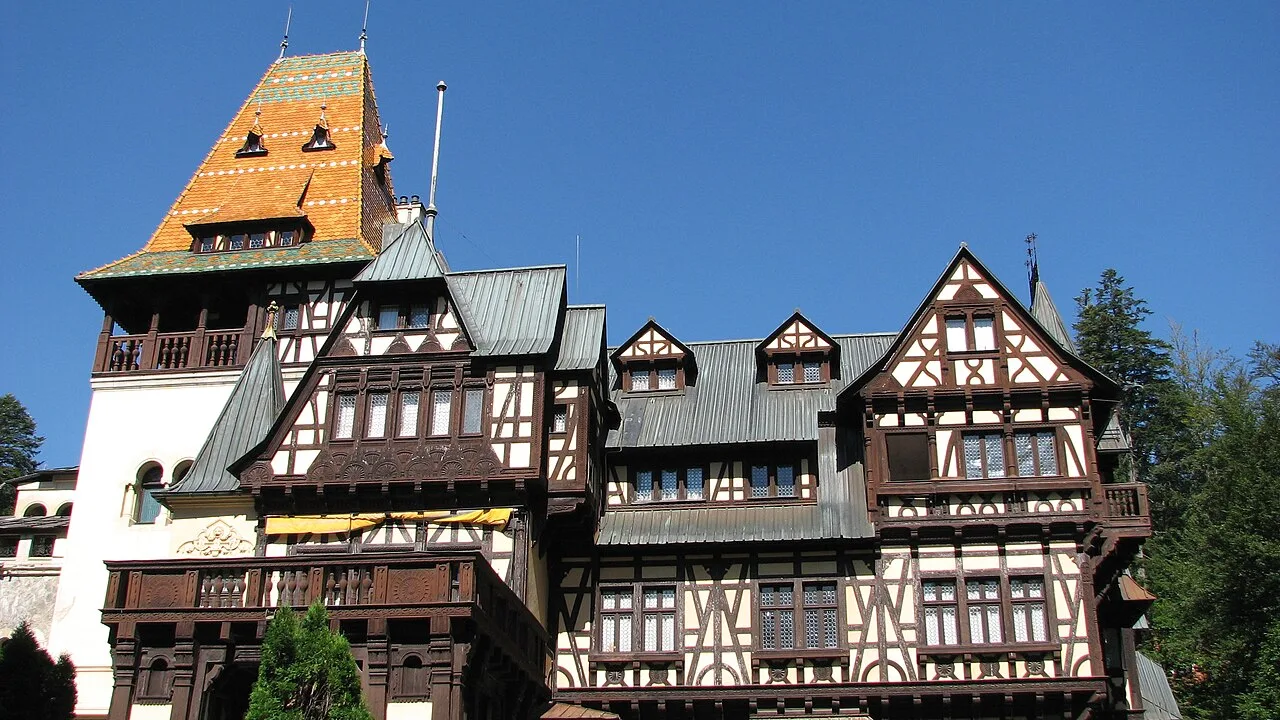
Pelisor stands 350 metres uphill from Peles Castle, costs 30 lei to enter, and is not a smaller version of its famous neighbour. It’s a separate ticket, a separate time slot and a completely different building: where Peles is a heavy German fantasy of carved walnut, armour and stained glass, Pelisor is Queen Marie’s own Art Nouveau house, lighter, stranger and far quieter. To see both in a day, book the 09:15 Peles slot and the 12:00 Pelisor slot, because the two slot grids don’t line up.
The other trap is the calendar. The castles close for maintenance at different times and the little one shuts first: in 2026 Pelisor is closed from 28 September to 3 November, while Peles runs through 1 November. So an October trip planned around the well-known line that “Peles closes in November” arrives to find the big castle open and the small one locked. Both dates come straight off the museum’s own site and they move from year to year, which is why you check them the week you book rather than trusting a blog post from two seasons ago.
What Pelisor actually is
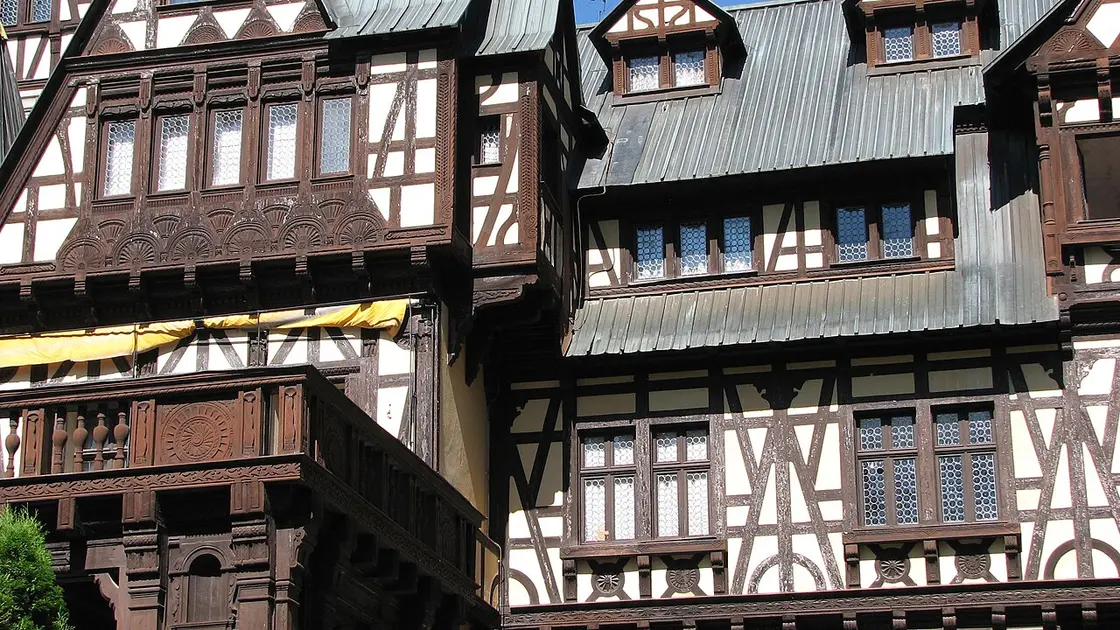
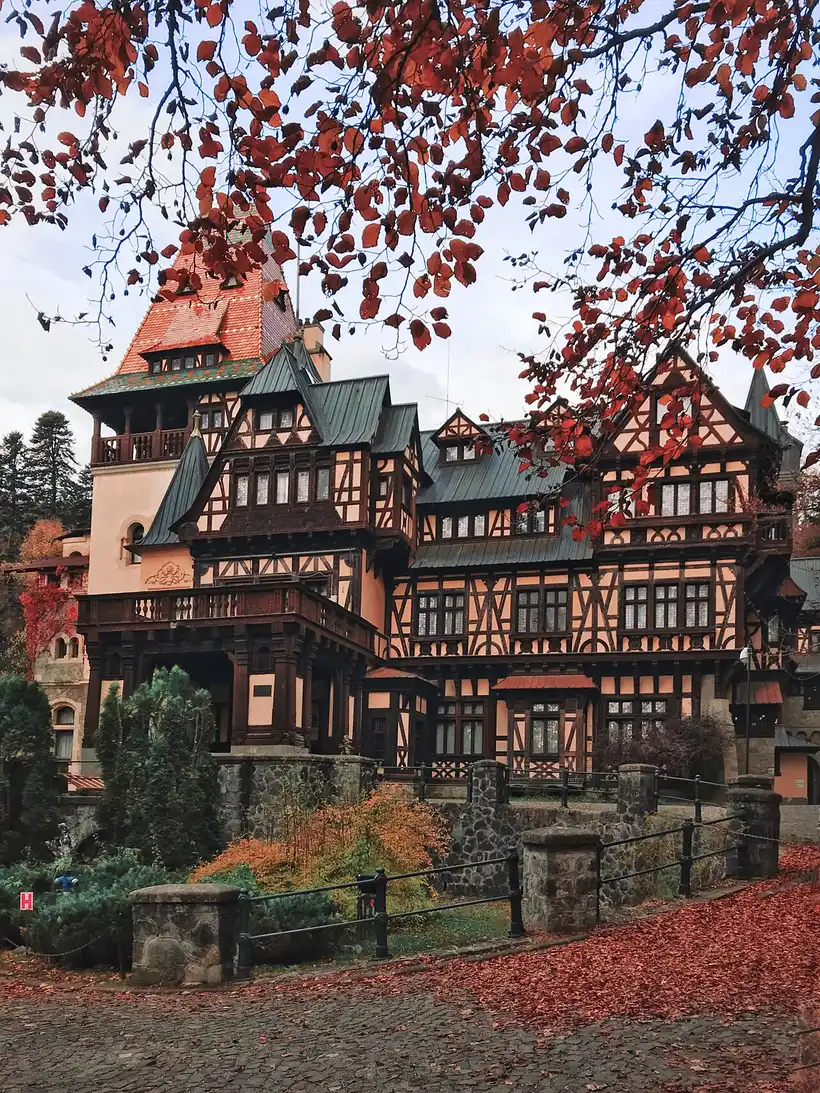
Carol I built it as a gift. The old king had already raised Peles for himself, and between 1899 and 1902 he added a house nearby for his heirs, his nephew Ferdinand and Ferdinand’s wife Marie. The chief architect was Karel Liman, the same Czech who worked on Peles, and outside he kept the family look: half-timbering, steep gables, dark carved balconies. Then he did something local with it. The two towers are roofed in coloured sandstone tiles laid in patterns borrowed from the church steeples of Bucovina, up in the north of the country, which is why the castle reads as cheerful rather than Teutonic even before you get inside.
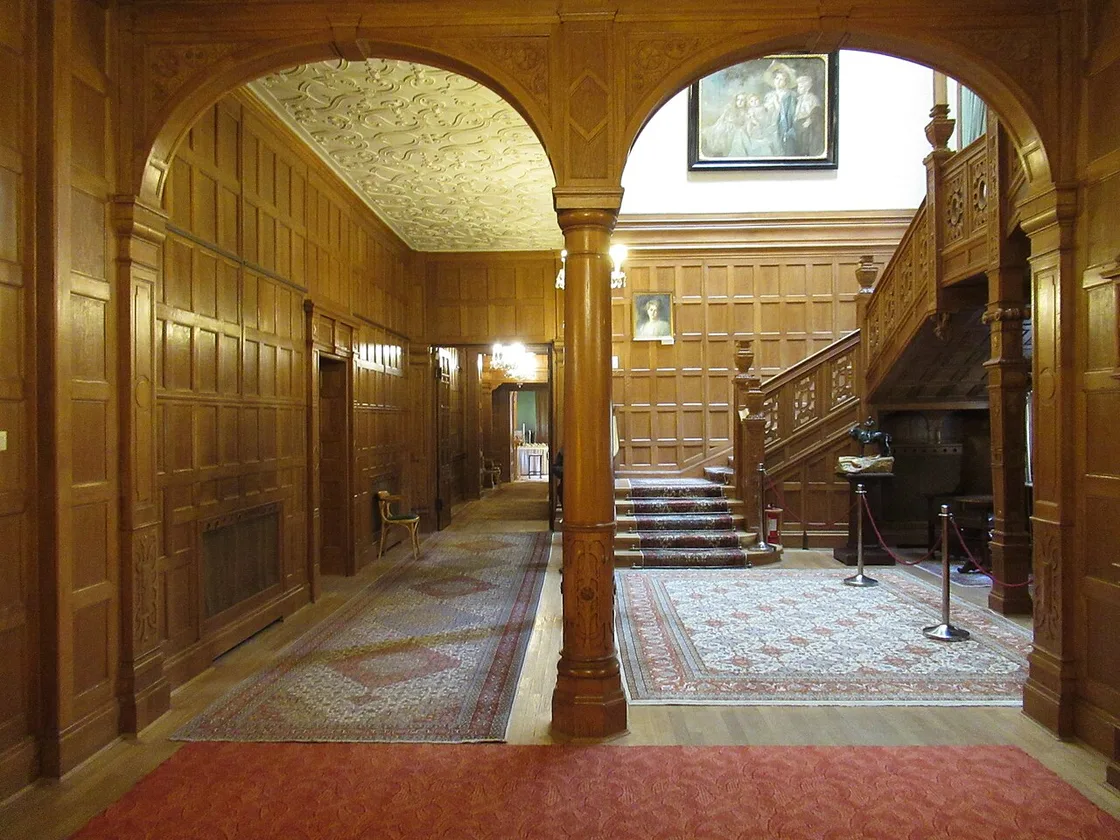
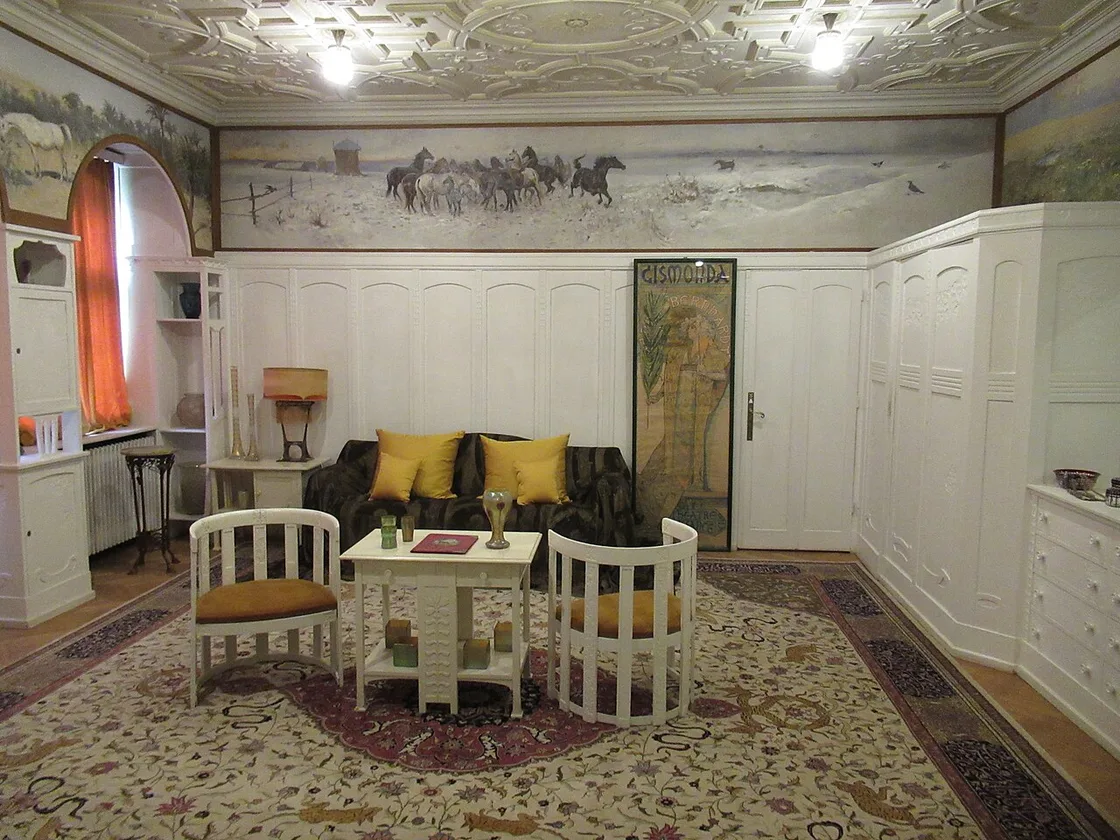
Inside, the seventy-odd rooms belong to Marie. She pushed Liman away from the heavy historicism next door and toward what Romanians still call “Art 1900”: Art Nouveau, crossed with Byzantine and Celtic motifs and with Romanian detail such as the wall niches of the Prahova valley. Much of the furniture came from the Viennese workshop of Bernhard Ludwig, and the glassware runs to Tiffany and Lalique. She worked on the interiors in two long campaigns, 1902 to 1903 and again from 1925 to 1928, so what you walk through is a quarter-century of one woman’s changing taste rather than a single decorator’s scheme.
That is the reason to buy the second ticket. Pelisor isn’t the servants’ wing of Peles or a consolation prize; it’s an argument with it. Carol I’s castle is dynastic, German and built to impress ambassadors. Marie’s house is personal, modern for its moment, and built to please one person who happened to be very good at this.
Tickets, hours and the slot system
Start with the detail that most visitors miss, because it’s the one that ruins a tight schedule: the two slot grids don’t line up. Thursday to Sunday, Peles sells 09:15-11:00, 11:00-12:45, 12:45-14:30 and 14:30-16:00, while Pelisor sells 09:15-12:00, 12:00-14:00 and 14:00-16:00. Book both for the same block and you’re gambling on being in two buildings at once. The pairing that works is the first Peles slot at 09:15 and the 12:00 slot at Pelisor: Peles takes about an hour and a quarter, and then you have the climb, the queue and a coffee before the second door.
A full tour of Pelisor is 30 lei for adults, 15 lei for pensioners and 7.5 lei for pupils, students and European Youth Card holders. That’s about 6 euros, under 7 dollars, or roughly 5 pounds at the National Bank of Romania’s official rate at the end of July 2026. Peles is a separate ticket at 100 lei for adults, and there’s no combined ticket, so seeing both means buying two and spending 130 lei, near enough 25 euros or 28.50 dollars. Romania is in the EU but not the eurozone, so all of this is payable in lei; our guide to money in Romania covers cards, cash and what the leu is worth.
Both castles keep the same hours: Wednesday 10:00 to 17:00, Thursday to Sunday 09:15 to 17:00, closed Monday and Tuesday. At Pelisor the last tickets go on sale at 16:10 and the last entry is 16:15. English-speaking groups form at the door on the hour, from 10:00 to 16:00 Thursday to Sunday and from 11:00 on Wednesdays, and the guide costs nothing extra, which is unusually generous for a house museum of this quality.
Since December 2025 tickets are sold only online at bilete.peles.ro or at the SelfPay machines beside the castles, which take cash and cards. You buy a specific date and a specific time slot, and entry inside that slot is first come, first served. Tickets are valid only on the day printed on them and cannot be refunded or rescheduled, so if you miss your train you’ve lost the ticket rather than earned an awkward conversation at the desk. Daily numbers are capped at 2,000 visitors for Peles and 1,500 for Pelisor.
The closure dates that ruin visits
Write these down. In 2026 Pelisor is closed from 28 September to 3 November for general cleaning and preventive conservation, and Peles is closed from 2 November to 1 December for the same work. The windows overlap, so on 2 and 3 November the whole royal estate is shut.
Flip that around and you get a piece of good news almost nobody acts on. If you’re travelling in November, the month everyone writes off in Sinaia, Pelisor reopens on 4 November and stays open while Peles is closed for the rest of the month. You get the mountain town in low season, snow on the Bucegi if you’re lucky, and a castle where the daily cap of 1,500 is a theoretical number rather than a queue. October is the reverse: Peles yes, Pelisor no.
These dates are set annually and shift, so treat the ones above as 2026 figures and confirm on peles.ro, then book the train. The same page carries shorter disruptions, road closures around the estate for races and works among them, which takes a minute to check and can change the day.
Queen Marie’s rooms, and the Golden Room
The room everyone comes for is the Camera de Aur, the Golden Room, which Marie designed herself. The walls are covered in gilded stucco thistle leaves, the furniture carries Celtic and Byzantine motifs, and the skylight in the ceiling is shaped like a Celtic cross. Guides will tell you the thistle is a nod to Scotland and her British childhood; others point out that the thistle is the emblem of Nancy, the French city that was the capital of Art Nouveau, and that Marie knew exactly what she was quoting. Nobody has settled it, and both readings say something true about her.
It’s also where she died. Marie was 62 when she went in that room on 18 July 1938, and she was buried at Curtea de Arges six days later. Her heart then travelled a great deal further than she did: sealed in a small gold casket, it was placed in her Stella Maris chapel at Balchik on the Black Sea, moved to Bran Castle in 1940 when that stretch of coast passed to Bulgaria, taken by the communist authorities to the National History Museum in Bucharest in 1971, and finally carried back to Pelisor on 3 November 2015. Seventy-seven years later it sits in the Golden Room, steps from where she died. That single fact explains the house better than any amount of architectural vocabulary.
Marie left a written testament to the country, and the museum quotes one line of it that is the best label anyone could hang on the place: “If all beautiful things remind you of me, I will be fully rewarded for the love I have borne you, because for me beauty was a creed.” Walk the rooms with that in mind and the odd mix of gilding, oak, Byzantine arches and Viennese chairs stops looking like indecision and starts looking like a manifesto. King Ferdinand died on the estate too, on 20 July 1927, though sources disagree about which of the two houses he was in.
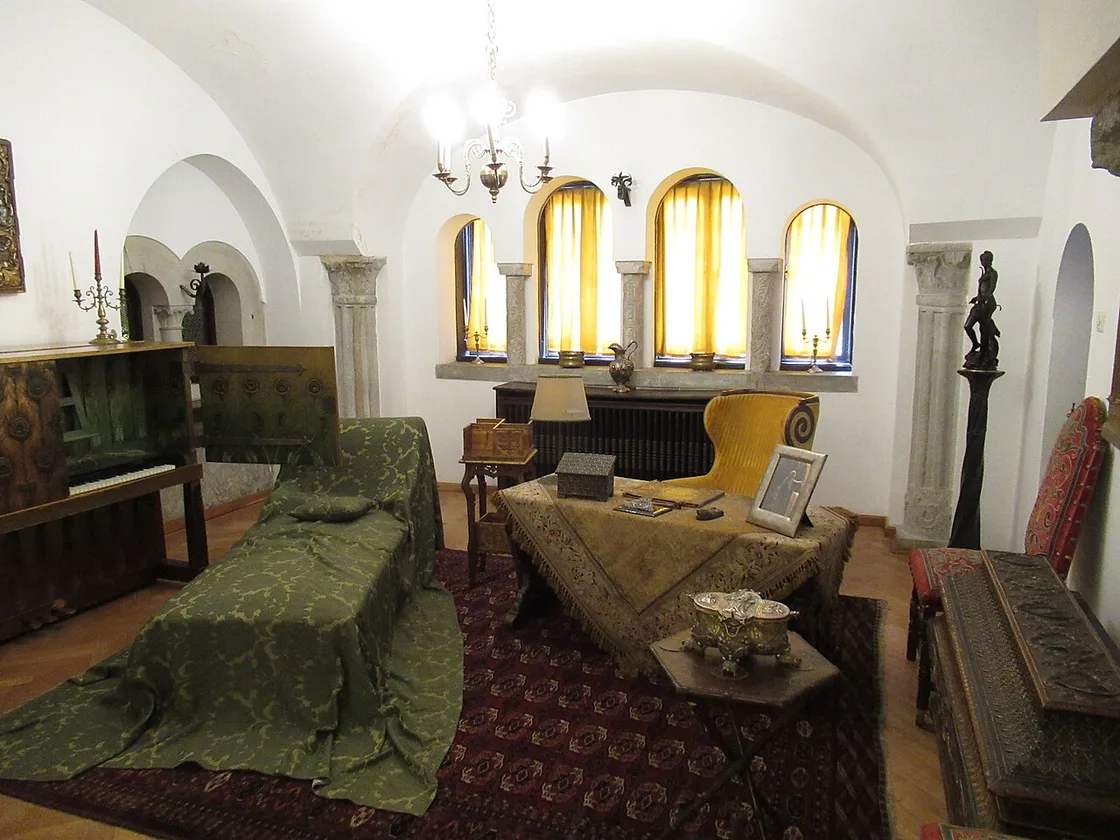
Pelisor or Peles: is the small one worth it?
One ticket in you? Buy Peles. It’s the bigger spectacle, and our guide to visiting Peles covers the 100-lei ticket, the crowd caps and the autumn shutdown in detail. But the second ticket is the better value per lei and per minute. Peles takes about 75 minutes and you move through it inside a group; Pelisor is a half-hour to an hour depending on how long you linger, holds 500 fewer people a day, and gives you rooms you can actually stand in front of.
The two also fail differently. Peles overwhelms: somewhere around the fifteenth carved ceiling you stop seeing them. Pelisor is small enough to hold in your head afterwards, which is why people who visit both tend to talk about Pelisor on the way home. If you’re weighing Romanian castles more broadly, our ranking of Romania’s castles sets Peles, Bran, Corvin and the rest against each other, and the Bran versus Peles comparison settles the two that most itineraries fight over.
How to get to Pelisor
Sinaia sits on the main railway between Bucharest and Brasov, so this works without a car: reckon on an hour and a half to two hours from Bucharest and about an hour from Brasov, check the current CFR Calatori timetable rather than an aggregator, and note the last train back if you are eyeing the later slots. Getting from the station up to the estate is the same problem for both castles, and our Peles guide covers that climb and what a taxi costs.
The leg that belongs to Pelisor is the last one. From the Peles terrace you keep going uphill along the park lane instead of turning back down through the souvenir stalls: 350 metres, about five minutes, past a row of half-timbered service buildings. Plenty of people never make it, and the museum’s own caps say as much, 2,000 tickets a day for Peles against 1,500 for Pelisor. The entrances and the queues are separate, so walk it with time in hand rather than at a jog.
Driving only pays if you’re touring the wider region, and there’s no motorway shortcut: the A3 runs as far as Ploiesti, after which it’s the DN1 up the Prahova valley, two to two and a half hours from Bucharest. The DN1 sets solid on Friday evenings going up and Sunday evenings coming back. With a car you can chain the castles the classic way, which our Peles to Bran guide lays out stop by stop.
How to plan the day
Buy both tickets the night before, take the 09:15 Peles slot and the 12:00 Pelisor slot, and spend the hour in between on Sinaia Monastery, roughly 15 minutes downhill and the same back up, free to look around, and the reason the town has its name. Our Sinaia guide covers what else fills the afternoon.
Sleeping in Sinaia takes the pain out of the 09:15 slot, since the alternative is a very early train out of Bucharest to reach a castle that starts turning people away by mid-morning. And if you get to choose the month, choose November after the 4th: Pelisor reopens, Peles is closed, the coaches have gone, and Marie’s rooms are close to empty for 30 lei. Failing that, look at the events page on peles.ro before you fix a date: the museum rotates temporary exhibitions through the year - in summer 2026 it was a show on Ferdinand and Marie inside Pelisor - and a good one is worth building the day around.
Photos
On the map
The map loads on click - to keep the page lightweight.
The map didn’t load. Check your connection and refresh the page.
Admission and opening hours
- Admission price
- Pelisor full tour: adults 30 lei, pensioners 15 lei, pupils and students 7.5 lei, European Youth Card 7.5 lei. Peles next door is a separate ticket at 100 lei for adults. There is no combined ticket: seeing both means buying two, 130 lei in total, roughly 25 EUR or 28.50 USD.
- Opening hours
- Wednesday 10:00-17:00, Thursday to Sunday 09:15-17:00, closed Monday and Tuesday. Entry is by booked time slot; last tickets 16:10, last entry 16:15. Pelisor is closed 28 September - 3 November 2026 for cleaning and conservation; Peles is closed for its own autumn maintenance every year, 2 November - 1 December in 2026.
Tickets are sold online at bilete.peles.ro and at the SelfPay machines beside the castles, are valid only on the day and slot you booked, and cannot be refunded or rescheduled. Prices, hours and the annual closure dates change: confirm on peles.ro before you travel.
Details checked: August 1, 2026
Read also

What to see · 11 min read
Marginimea Sibiului: Shepherd Villages Near Sibiu
Verified · September 5, 202618 shepherd villages west of Sibiu: Rasinari, Sibiel glass icons, Saliste, Paltinis bus fares, and how a day out of town works.

What to see · 9 min read
Prejmer Fortified Church: UNESCO Near Brasov
Verified · September 3, 2026Prejmer fortified church 15 km from Brasov: Greek-cross plan, 275 wall rooms, UNESCO hours for 2026 and how a visit actually works.

What to see · 11 min read
ASTRA Museum Sibiu: Romania's Great Open-Air Village
Verified · August 29, 2026ASTRA Museum near Sibiu: 50-lei tickets, hours by season, how to get there, and which of the 400+ buildings across 96 hectares to see first.

What to see · 10 min read
Bucegi Sphinx & Babele: Cable Car from Busteni
Updated · August 26, 2026Ride the Busteni cable car to the Sphinx and Babele: 2026 return fare 199 lei, hours from 08:30, and how to pair it with Peles or Cantacuzino.